I had a class tonight, so I DVR'd the A's game. It proved to be the last day of their season.
No criticism here. They played their hearts out. Half their team is rookies, most of the other half consists of players within the first three years of MLB experience. There's no depth on a team with one-third the salary budget of the Boston Red Sox. You think it's a miracle when they're in the running at the end. In truth, they were the best team in baseball for two months down the stretch.
But I mourn. I do this every year. It should be easier. It isn't. As I hug my dogs, I watch the last out with a kind of peace. What a thrill to watch this young team this year. What a wonderful year it was. It just ended six games too soon.
Wednesday, September 28, 2005


Thursday, September 15, 2005
Welcome to Davies Hall
I visited Davies Hall in San Francisco today for a concert conducted by Michael Tilson Thomas (MTT) and featuring Midori, the acclaimed violinist.
I don't like the way Davies Hall is laid out, I thought to myself as I purchased some lukewarm Earl Grey and a cookie. It's beautiful to look at from the outside, to be sure, but once you go in, there's no way to go but up either steep stairs or in an elevator that only holds about 6 people. There are no restrooms on the main floor, a fact which baffles me, so it's down or up the stairs again. I adore the Side Terrace seats, which give you a great view of the musicians, their faces, even their scores. But those seats offer truly diminished legroom. It's like flying on British Airtours all over again.
Still, you can't argue with the acoustics. Well, you could if this were 1980. Davies Hall celebrates its 25th annniversary this year, and has had its share of controversy. The construction of Davies Hall gave the symphony, founded in 1911 as sort of a pick-up band, a building of its own. Before, the symphony shared space with the San Francisco Opera as well as the Ballet in a number of buildings (the Columbia Theatre, the Curran, the Tivoli Opera House, the War Memorial Opera House).
Davies Hall was an instant success -- "A place to see and be seen," "fabulous!" it was declared. However the critics raved, however, there was usually a little topspin, a small comment about how "noisy" the hall was. Those on stage noted that it was impossible to hear each other. As cellist Peter Shelton once noted, "Playing musically (was) an act of defiance."
After 12 years of musical confusion, the Davies Symphony Hall underwent an acoustic makeover, starting in 1991 and carried out over two summers. Phase One called for replacement of the 19 acrylic dishes suspended over the stage. They were transformed into 59 plexiglass panels which made up an acoustic canopy. Any panel could be adjusted electronically. In Phase Two, the hall was taken apart and reassembled. Many ideas were instituted to ensure the best sound creation. When all was done, the Hall was smaller by about 300 seats. The price tag for the remodel was about $10 million. Critics have noted that the payoff was immediate. The confusing echoes were gone, replaced with a warmth and intimacy.
While I was sitting in my Side Terrace seat for the concert today, a seat, by the way, which was changed at the last minute because they were filming, someone asked me if I thought the sound was different here on the side. "I don't know," I said honestly, "but I don't see how it could be better anywhere else."
Today we were to be treated to a rare appearance by Midori. I say "rare" probably because I've heard of her but never seen her. But, in truth, she seems to be all over the place: she does over 100 performances a year, and in addition, has many other projects she's working on, many charitable, all beneficial to the music world. There are so many stories about Midori, and yet she's only 34 years old. My favorite is the one where, at the age of 16, her E string broke on her violin as she was playing Bernstein, and was offered the violin of the concertmaster's. When that E string broke as well, she was given the violin of the associate concertmaster's. Both violins were much larger than hers, but she persevered. She is a legend among musicians, and the stories grow.
The place was packed, the first time I had seen it thus during a matinee. The two young Japanese sitting next to me (they spoke no English while seated next to me) were there for one reason: to see Midori play. They dutifully sat through the Copland to get to Prokofiev's Violin Concerto No. 1 in D Major, the structure during which Midori would shine.
She did shine. She did other things, too, as her body never stayed still. I was worried that in my new seat I wouldn't be able to see the musicians' faces or watch Midori play. I needn't have worried. My new vantage point was satisfactory, especially for the musicians, as I was above them to their left side, and could even watch the pages of the scores being turned. Midori, however, twisted and turned so that I, rather than those in the orchestra seats, was able to watch her face during the entire performance.
From the very first note she closed her eyes. There was no score for her to follow. She was alone on stage. But she was busy, her upper torso twisting this way and that, her bow flying off the strings. MTT was standing right next to her, on her left, and maybe just a little too close. With her schizophrenic jerks, I felt she was going to whack him in the head with her bow. But thankfully that never happened. MTT has quite the reputation as an emotional conductor, but he seemed quite subdued during this performance. Perhaps he, too, was worried about being hit by Midori's flying bow and wanted to stay perfectly still.
During one part of the Prokofiev, during the 2nd movement, I believe, Midori began to seesaw on the strings, running her bow hard, back and forth, in a grating fashion. It really was the most unpleasant sound, like someone sawing through an expensive violin. In fact, I double-clutched, peering to see if something was wrong with her violin. MTT didn't seem disturbed; neither did she. I presumed it was part of the passage, and when she retreated back to melodic, beautiful upper-register notes, I sat back and enjoyed the rest of the concert.
Hers was a virtuoso performance. The young Japanese couple next to me talked animatedly immediately after the performance, obviously praising her virtuosity. They seemed very pleased. Midori enjoyed three callbacks in applause, but she did not represent the best of the concert.
Copland's Fanfare for the Common Man was short but miraculous, amazing in its brevity but quickly evocative of early Americana, and performed brilliantly by the brass and especially the clarinetist. Tilson Thomas especially seemed elated at the conclusion, going around to shake everyone's hand and acknowledge them publicly.
The Dvorak was also divine (Symphony No. 8 in G major). As the Playbill warned me, I wondered how such an inspiring piece could have so many minor notes. MTT threw himself into conducting, using his body, his arms, his eyes, his chin -- everything -- to indicate to musicians what he wanted. They answered with precision and strength.
Michael Tilson Thomas seems to be a conductor made for the "new" Davies Symphony Hall. He uses the Hall's virtues to its extremes, and is a pleasure to watch. He truly is a performer, even though his job is to command, even urge, the performance. MTT, the San Francisco Symphony, and even Davies Hall are a pleasure to watch and hear.
(Thanks to the Sept 2005 Playbill for the information on the remodel of Davies Hall as well as the selections in today's concert.)
I don't like the way Davies Hall is laid out, I thought to myself as I purchased some lukewarm Earl Grey and a cookie. It's beautiful to look at from the outside, to be sure, but once you go in, there's no way to go but up either steep stairs or in an elevator that only holds about 6 people. There are no restrooms on the main floor, a fact which baffles me, so it's down or up the stairs again. I adore the Side Terrace seats, which give you a great view of the musicians, their faces, even their scores. But those seats offer truly diminished legroom. It's like flying on British Airtours all over again.
Still, you can't argue with the acoustics. Well, you could if this were 1980. Davies Hall celebrates its 25th annniversary this year, and has had its share of controversy. The construction of Davies Hall gave the symphony, founded in 1911 as sort of a pick-up band, a building of its own. Before, the symphony shared space with the San Francisco Opera as well as the Ballet in a number of buildings (the Columbia Theatre, the Curran, the Tivoli Opera House, the War Memorial Opera House).
Davies Hall was an instant success -- "A place to see and be seen," "fabulous!" it was declared. However the critics raved, however, there was usually a little topspin, a small comment about how "noisy" the hall was. Those on stage noted that it was impossible to hear each other. As cellist Peter Shelton once noted, "Playing musically (was) an act of defiance."
After 12 years of musical confusion, the Davies Symphony Hall underwent an acoustic makeover, starting in 1991 and carried out over two summers. Phase One called for replacement of the 19 acrylic dishes suspended over the stage. They were transformed into 59 plexiglass panels which made up an acoustic canopy. Any panel could be adjusted electronically. In Phase Two, the hall was taken apart and reassembled. Many ideas were instituted to ensure the best sound creation. When all was done, the Hall was smaller by about 300 seats. The price tag for the remodel was about $10 million. Critics have noted that the payoff was immediate. The confusing echoes were gone, replaced with a warmth and intimacy.
While I was sitting in my Side Terrace seat for the concert today, a seat, by the way, which was changed at the last minute because they were filming, someone asked me if I thought the sound was different here on the side. "I don't know," I said honestly, "but I don't see how it could be better anywhere else."
Today we were to be treated to a rare appearance by Midori. I say "rare" probably because I've heard of her but never seen her. But, in truth, she seems to be all over the place: she does over 100 performances a year, and in addition, has many other projects she's working on, many charitable, all beneficial to the music world. There are so many stories about Midori, and yet she's only 34 years old. My favorite is the one where, at the age of 16, her E string broke on her violin as she was playing Bernstein, and was offered the violin of the concertmaster's. When that E string broke as well, she was given the violin of the associate concertmaster's. Both violins were much larger than hers, but she persevered. She is a legend among musicians, and the stories grow.
The place was packed, the first time I had seen it thus during a matinee. The two young Japanese sitting next to me (they spoke no English while seated next to me) were there for one reason: to see Midori play. They dutifully sat through the Copland to get to Prokofiev's Violin Concerto No. 1 in D Major, the structure during which Midori would shine.
She did shine. She did other things, too, as her body never stayed still. I was worried that in my new seat I wouldn't be able to see the musicians' faces or watch Midori play. I needn't have worried. My new vantage point was satisfactory, especially for the musicians, as I was above them to their left side, and could even watch the pages of the scores being turned. Midori, however, twisted and turned so that I, rather than those in the orchestra seats, was able to watch her face during the entire performance.
From the very first note she closed her eyes. There was no score for her to follow. She was alone on stage. But she was busy, her upper torso twisting this way and that, her bow flying off the strings. MTT was standing right next to her, on her left, and maybe just a little too close. With her schizophrenic jerks, I felt she was going to whack him in the head with her bow. But thankfully that never happened. MTT has quite the reputation as an emotional conductor, but he seemed quite subdued during this performance. Perhaps he, too, was worried about being hit by Midori's flying bow and wanted to stay perfectly still.
During one part of the Prokofiev, during the 2nd movement, I believe, Midori began to seesaw on the strings, running her bow hard, back and forth, in a grating fashion. It really was the most unpleasant sound, like someone sawing through an expensive violin. In fact, I double-clutched, peering to see if something was wrong with her violin. MTT didn't seem disturbed; neither did she. I presumed it was part of the passage, and when she retreated back to melodic, beautiful upper-register notes, I sat back and enjoyed the rest of the concert.
Hers was a virtuoso performance. The young Japanese couple next to me talked animatedly immediately after the performance, obviously praising her virtuosity. They seemed very pleased. Midori enjoyed three callbacks in applause, but she did not represent the best of the concert.
Copland's Fanfare for the Common Man was short but miraculous, amazing in its brevity but quickly evocative of early Americana, and performed brilliantly by the brass and especially the clarinetist. Tilson Thomas especially seemed elated at the conclusion, going around to shake everyone's hand and acknowledge them publicly.
The Dvorak was also divine (Symphony No. 8 in G major). As the Playbill warned me, I wondered how such an inspiring piece could have so many minor notes. MTT threw himself into conducting, using his body, his arms, his eyes, his chin -- everything -- to indicate to musicians what he wanted. They answered with precision and strength.
Michael Tilson Thomas seems to be a conductor made for the "new" Davies Symphony Hall. He uses the Hall's virtues to its extremes, and is a pleasure to watch. He truly is a performer, even though his job is to command, even urge, the performance. MTT, the San Francisco Symphony, and even Davies Hall are a pleasure to watch and hear.
(Thanks to the Sept 2005 Playbill for the information on the remodel of Davies Hall as well as the selections in today's concert.)
Saturday, August 27, 2005
It's Still Rock 'n Roll to Me
I was talked into this. I didn't want to go. But it was a chance to see Tom Petty and his Heartbreakers, one of the last true American bands.
George had given me his Tom Petty two-CD set to listen to to prepare. He likes to put the CD's in his car and blast them throughout his commute so that he's ready for the concert. I listened to the CD, yes, but only the songs I liked. I didn't have time for the other 30 songs! Petty has certainly produced an incredible number of tunes over the last two decades. Then there's his Traveling Wilbury stuff. It just goes on and on.
George, Pamela, Scott, and I were sitting on the very uncomfortable bleacher seats at the Greek Theatre on the UC Berkeley campus, when Jamie and his friend Dan showed up and threaded their way into the row, looking for their seats. The opening act, the Black Crowes, were just at the end of their set and the sun hadn't even gone behind the facade yet.
Jamie was surprised to see me. Since I offered him two seats, he thought I had given him my ticket. Naw, they were George's tickets that his wife and his other daughter couldn't use, and he had given them to Rick, who....sheesh, never mind. Anyway, two free tickets went to UCSC Santa Cruz, and the two banana slugs invaded UC Berkeley territory.
So I found myself sitting on concrete seats that were small and getting smaller as we all tried to squeeze our butts together on this ungiving slab. I believe there were kids sitting there who had grass tickets, but who really knows. There were no real ushers. I think the girl next to me stood up most of the time, just to avoid having her butt squeezed into a size 3. The right side of her body obscured the left side of the stage in my vision, but I decided I could live with that.
Uncomfortable seats, but a great view from almost the last row of assigned seats. Tom Petty really performed like the professional he is. I knew perhaps 5 songs but I enjoyed the songs I didn't know, a tribute to his penchant for writing songs that are immediately hummable and catchy, often with terrific, soulful lyrics. And I got to watch an excited George jump up and down when Petty started doing the song George had awaited -- I've forgotten the name -- but it was a driving, pounding song that I imagined assisted George in driving to work.
The average age of the audience was about 25, and I wondered how these kids even knew about Tom Petty. He was on the fringe of my consciousness, to be sure, and I only found out about him through adeptly performed cover songs by the likes of Linda Ronstadt. These cover songs didn't have the plaintive wailing of his whining voice, a quality that actually adds to something like "Live like a Refugee," my personal favorite. And the two types of cigarette smoke wafting back into my area (and lit up by the spotlights) seemed to be coming from people who were my contemporaries.
I'm glad I didn't even have a taste of alcohol. We had to carefully walk over the litter of plastic bottles all over the stadium in order to find the narrow passageway out. And then down steep stairs to get to the street which would lead me to my parking area.
Great time, bad venue. Love the music, hate the Greek.
George had given me his Tom Petty two-CD set to listen to to prepare. He likes to put the CD's in his car and blast them throughout his commute so that he's ready for the concert. I listened to the CD, yes, but only the songs I liked. I didn't have time for the other 30 songs! Petty has certainly produced an incredible number of tunes over the last two decades. Then there's his Traveling Wilbury stuff. It just goes on and on.
George, Pamela, Scott, and I were sitting on the very uncomfortable bleacher seats at the Greek Theatre on the UC Berkeley campus, when Jamie and his friend Dan showed up and threaded their way into the row, looking for their seats. The opening act, the Black Crowes, were just at the end of their set and the sun hadn't even gone behind the facade yet.
Jamie was surprised to see me. Since I offered him two seats, he thought I had given him my ticket. Naw, they were George's tickets that his wife and his other daughter couldn't use, and he had given them to Rick, who....sheesh, never mind. Anyway, two free tickets went to UCSC Santa Cruz, and the two banana slugs invaded UC Berkeley territory.
So I found myself sitting on concrete seats that were small and getting smaller as we all tried to squeeze our butts together on this ungiving slab. I believe there were kids sitting there who had grass tickets, but who really knows. There were no real ushers. I think the girl next to me stood up most of the time, just to avoid having her butt squeezed into a size 3. The right side of her body obscured the left side of the stage in my vision, but I decided I could live with that.
Uncomfortable seats, but a great view from almost the last row of assigned seats. Tom Petty really performed like the professional he is. I knew perhaps 5 songs but I enjoyed the songs I didn't know, a tribute to his penchant for writing songs that are immediately hummable and catchy, often with terrific, soulful lyrics. And I got to watch an excited George jump up and down when Petty started doing the song George had awaited -- I've forgotten the name -- but it was a driving, pounding song that I imagined assisted George in driving to work.
The average age of the audience was about 25, and I wondered how these kids even knew about Tom Petty. He was on the fringe of my consciousness, to be sure, and I only found out about him through adeptly performed cover songs by the likes of Linda Ronstadt. These cover songs didn't have the plaintive wailing of his whining voice, a quality that actually adds to something like "Live like a Refugee," my personal favorite. And the two types of cigarette smoke wafting back into my area (and lit up by the spotlights) seemed to be coming from people who were my contemporaries.
I'm glad I didn't even have a taste of alcohol. We had to carefully walk over the litter of plastic bottles all over the stadium in order to find the narrow passageway out. And then down steep stairs to get to the street which would lead me to my parking area.
Great time, bad venue. Love the music, hate the Greek.
Built for Comfort, Not for Speed
Rick and I tackled the 10K walk/run at the Hayward shoreline this morning. We were both a little nervous about it.
Unlike the Faith Fancher 5K walk last weekend, which was more a community get-together than a well-organized event aimed at encouraging healthy ways (it included a BBQ at the end of the event), this event was structured in satisfying ways. I got to pin a number on my t-shirt, and, as we waited for the walk, a fund-raising event for the park, we talked with Molly.
Molly is a runner, and we knew she'd be spurting ahead of us. I asked her how she dealt with water and bathroom needs during a longer run. She said it depends on whether she's watching her time. She didn't think she would need either during this "short" run. Molly has been known to participate in marathons that dwarf official marathons. She did add that one of the organizers said there was a port-a-potty "somewhere on the trail," but he couldn't remember where.
That eased my mind a bit as we prepared for the push-off. Somewhere out there is a toilet, in case I need it. I just have to find it. A diabetic who has had their colon shortened sometimes cannot predict the need for such things. It makes me nervous to think that I will be out on the trail for 3 hours, and makes me stop drinking the water I really should be consuming.
Immediately after the race began I fell to last place. I kept telling myself, "this is not a competition, this is not a competition," over and over. But I knew Rick's male brain was telling him, "This is a competition, this is a competition," and, true enough, he spurted out, not at the head of the running competition, but among the fast walkers. I wouldn't see him again until the end.
I stayed with some of the stragglers until they turned left to join the 5K walk. Since I had pledged to do the 10K, I stayed to the right and found myself all alone. I kept up a pretty good pace, a pretty steady one, through the first 3 miles. I told myself I could relax a bit once I reached the half-way mark.
Along the way they had water stations. The first two had eager volunteers with dozens of cups of water available. At about the 3.5-mile mark, I found a deserted water station; I helped myself to a swallowful. After that, I didn't find another.
It's a lonely trek, but I found I enjoyed that. Being careful not to drag my feet and stumble in my growing fatigue, I still found myself keeping a pretty good pace, albeit a slower one, after the 3-mile mark. Once I got past the drainage canal, there were no walkers, bicyclists or dogs to occasionally pass. There were the birds, the squirrels and me. And my thoughts.
At about the four-mile point, a tall olive-green obelisk, like the one in the movie "2001," grew on the horizon. Could it be...? A thing of beauty it was, and it grew larger with every purposeful step. The porta-potty. I knew it was mine alone, as there was no other human around. I think I could have made it all the way through the 6.5 miles this morning, but I wasn't certain. And after my visit with this wonderful manmade invention, I was certain I could walk until the end.
The last two miles I found a bit slow-going. I could feel my quads complaining, but not screaming. My back hurt, though, probably because of my posture. I tried to keep my form throughout the walk -- arms bent at the elbows and pumping, pelvic tilt -- but I always look down at the road, lest I stumble, and that's probably the problem. The longer I walked, the more my back ached.
There were no markers in the last two miles, no water stations, no walkers, no nothing. About a 100 yards before the station house, a truck pulled past me, picking up the remaining cones from the walk/run. When I got to the station, Rick was standing there waiting for me. Only a few volunteers remained, cleaning up, and nobody told me my time or "way to go" or anything. It was the lonely conclusion to a lonely walk. I was the last one to come in, and they hadn't even known the last participant was still out there.
But I wasn't there to compete or race, or even get the camaraderie of walking with a group. I was there to challenge myself. My goal was to finish. And I did that, at my own pace. As Dianne Davidson once sang, I'm built for comfort. I ain't built for speed.
Unlike the Faith Fancher 5K walk last weekend, which was more a community get-together than a well-organized event aimed at encouraging healthy ways (it included a BBQ at the end of the event), this event was structured in satisfying ways. I got to pin a number on my t-shirt, and, as we waited for the walk, a fund-raising event for the park, we talked with Molly.
Molly is a runner, and we knew she'd be spurting ahead of us. I asked her how she dealt with water and bathroom needs during a longer run. She said it depends on whether she's watching her time. She didn't think she would need either during this "short" run. Molly has been known to participate in marathons that dwarf official marathons. She did add that one of the organizers said there was a port-a-potty "somewhere on the trail," but he couldn't remember where.
That eased my mind a bit as we prepared for the push-off. Somewhere out there is a toilet, in case I need it. I just have to find it. A diabetic who has had their colon shortened sometimes cannot predict the need for such things. It makes me nervous to think that I will be out on the trail for 3 hours, and makes me stop drinking the water I really should be consuming.
Immediately after the race began I fell to last place. I kept telling myself, "this is not a competition, this is not a competition," over and over. But I knew Rick's male brain was telling him, "This is a competition, this is a competition," and, true enough, he spurted out, not at the head of the running competition, but among the fast walkers. I wouldn't see him again until the end.
I stayed with some of the stragglers until they turned left to join the 5K walk. Since I had pledged to do the 10K, I stayed to the right and found myself all alone. I kept up a pretty good pace, a pretty steady one, through the first 3 miles. I told myself I could relax a bit once I reached the half-way mark.
Along the way they had water stations. The first two had eager volunteers with dozens of cups of water available. At about the 3.5-mile mark, I found a deserted water station; I helped myself to a swallowful. After that, I didn't find another.
It's a lonely trek, but I found I enjoyed that. Being careful not to drag my feet and stumble in my growing fatigue, I still found myself keeping a pretty good pace, albeit a slower one, after the 3-mile mark. Once I got past the drainage canal, there were no walkers, bicyclists or dogs to occasionally pass. There were the birds, the squirrels and me. And my thoughts.
At about the four-mile point, a tall olive-green obelisk, like the one in the movie "2001," grew on the horizon. Could it be...? A thing of beauty it was, and it grew larger with every purposeful step. The porta-potty. I knew it was mine alone, as there was no other human around. I think I could have made it all the way through the 6.5 miles this morning, but I wasn't certain. And after my visit with this wonderful manmade invention, I was certain I could walk until the end.
The last two miles I found a bit slow-going. I could feel my quads complaining, but not screaming. My back hurt, though, probably because of my posture. I tried to keep my form throughout the walk -- arms bent at the elbows and pumping, pelvic tilt -- but I always look down at the road, lest I stumble, and that's probably the problem. The longer I walked, the more my back ached.
There were no markers in the last two miles, no water stations, no walkers, no nothing. About a 100 yards before the station house, a truck pulled past me, picking up the remaining cones from the walk/run. When I got to the station, Rick was standing there waiting for me. Only a few volunteers remained, cleaning up, and nobody told me my time or "way to go" or anything. It was the lonely conclusion to a lonely walk. I was the last one to come in, and they hadn't even known the last participant was still out there.
But I wasn't there to compete or race, or even get the camaraderie of walking with a group. I was there to challenge myself. My goal was to finish. And I did that, at my own pace. As Dianne Davidson once sang, I'm built for comfort. I ain't built for speed.
Saturday, August 20, 2005
Play Like a Pro
I started preparing for the Play Like a Pro Day a week ago.

I treat each upcoming event as a project, much as I did when I was working. I give the project lead time, prepare a mental if not a written list of what I must do to prepare, and then schedule it during the lead time, usually a week.
The one requirement the notice from the A’s mentioned was that I needed a glove. I have never owned a baseball glove in my life. Hell, I hadn’t even thrown a baseball or softball in 10 years, and hadn’t worn a glove in 30 years. So when I returned from my latest trip, the first thing on my list: Get a glove.
Rick’s suggestion to go to Play It Again Sports in Fremont was a good one. I found a really really used glove for $10 plus tax. It was an outfielder’s glove, and thanks to my insistence that it be a hardball glove and not a softball glove, it had a great pocket. Not a great deal of padding for an 80-mile-an-hour fastball, but good enough.
The next step was finding someone to practice with. My roommate graciously gave up a half hour on a Friday afternoon, one day before the event, to play catch with me. Luckily she found her own glove, hidden for a couple of years in the trunk of her car. Our high lobs toward each other steadily grew into harder throws, encouraging me that, hey! Maybe old habits don’t die out completely. In the face of emergency, you go back to your training, right?
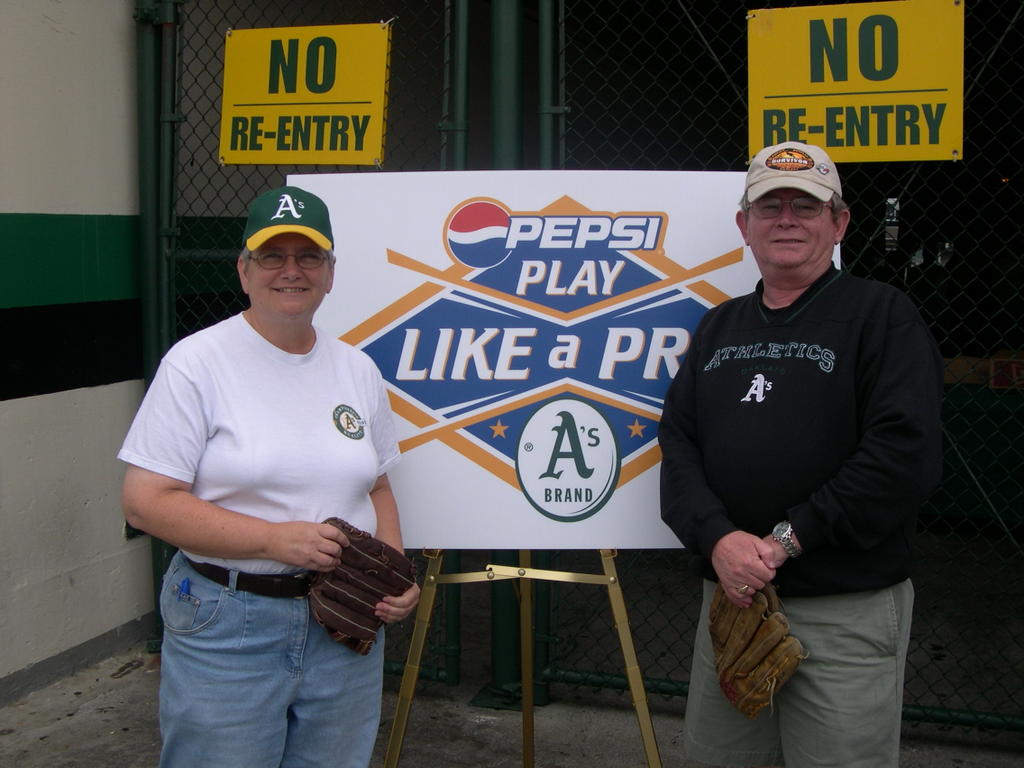
So on Saturday, August 20, 2005, Rick and I walked the Faith Fancher Cancer Awareness 5K at Lake Merritt in Oakland, and then turned our attention to the A’s clinic. We arrived at 12:15 at Gate D, and joined about 75 other people in line. Check-in was easy, and they gave each of us an A’s cap and a ticket to tonight’s game against the Kansas City Royals.
Rick looked at me and said, “Are we the oldest ones here?” We looked around at the fans, average age maybe 35, and admitted, “It’s close!” Real close.
The P.R. guy took us to the MVP seats above the dugout, told us what to expect of the day, and then led us onto the field through the box. He had split all of us into five groups of about 15 people each. Each group had a player assigned to it, and each player had a responsibility to cover his subject matter, thusly:
Eric Chavez – hitting
Rich Harden – pitching
Bobby Crosby – infield
Mark Kotsay – outfield
Jason Kendall - catching
When we all saw the players, we broke into spontaneous applause! This wasn’t the “B” Team they were throwing at us – these were the All Stars!
 Rick and I were in Group #1, so we headed over to Eric Chavez, who was quietly waiting for us by the backstop. He was standing by a t-ball set-up, and there were a couple of bats by his feet. However, he quickly discovered that our group only wanted to talk to this great player, not try hitting. There were only about 20 minutes spent with him, and they weren’t going to waste their time.
I saw as I glanced up that Bobby Crosby had his first group fielding balls. They were throwing ground balls to each other and using their gloves, and he would throw in comments occasionally. But my group never wanted to do that. We just talked to each player and sometimes took some quick pictures of each.
Here are a few comments from each of the players. Most of these comments weren’t really solicited by the dumb questions we fans asked. Their in-depth answers were mainly created by the players themselves, and offered a unique perspective into what I was discovering to be a very difficult game to properly play.
Eric Chavez – Eric had a slight growth of beard and a very casual way of speaking to us. It seems foolish to say, but I was awestruck at the time re: how handsome and poised this young man was. In answer to Rick’s question, who’s the toughest pitcher you’ve ever faced, Eric answered “Pedro Martinez.” He said he hates to face him because Pedro’s ball moves so much. Chavez gave us several hitting tips, including the fact that he personally changes his stance daily to get a good look at the pitcher and his release point. He takes advantage of video so that, even during a game, he’ll duck into the video room to see himself in a previous at-bat against the same pitcher. “It’s a tremendous advantage,” he told us.

Rich Harden – Rich is tall but muscular, much more muscular than I thought a pitcher would look. He has an easy smile, a bit more than Chavez, but obviously takes his job seriously. He showed us the two-finger fastball and the four-finger fastball, and a few other pitches (where to put the fingers against the seams), and my most vivid memory of this moment was watching the 45-year-old woman next to me, obviously thrilled to be there, gripping her baseball in the same way, focusing on getting it right as if the next victory depended on it. When I congratulated Rich on his win of the night before, he laughed and said he really didn’t have it last night. He admitted that his fastball wasn’t working at all. As Jason Kendall would tell us later, it’s a good thing that Rich has three other rather nasty pitches. Rich told us that Manny Ramirez is probably the toughest hitter he has ever faced in his brief career. He said Manny will change his approach from at-bat to at-bat, the way the best ones do, and that inside pitch that worked so well against him last time could be the one he hits out next time. “Vladmir Guerrero can be easy or hard,” he reported. “If you hit your spots, it’s easy. That’s really what it comes down to.”
 Bobby Crosby – I noted Bobby was tall and thin when I met him during the FanFest celebration earlier this year. He seems so serious, rarely cracking a smile. He showed us how to tackle the ball when it’s coming towards you, how he tries to get a jump on the ball when it’s coming off the bat: “I imagine a little circle in front of me. When the hitter is going through his swing, before the bat hits the ball, I lean into the circle.” His legs start to move and he can control in which direction he moves to field the ball. The worst baserunner to him is Ichiro “and believe it or not, Benjie Molina.” Ichiro is so fast that Bobby gunslings the ball in an overhead fashion, picking up the ball as quickly as he can to gun it to first. “Sometimes I don’t have a good grip but I’ve gotta make that throw.” Benjie is tough because he’s the slowest baserunner you’ve ever seen, “and frankly I just don’t know what to do with all that time! I find myself thinking, ‘You better get this throw right.'” Bobby told us that it was awesome playing next to Chavez, as he covers more territory than the average third baseman. Would you rather play with Scutaro or Ellis? He smirked slightly and diplomatically said, “It doesn’t matter. They both put it where I want it” on a double play. He told us he talks to Ellis when someone’s on base, whereas he pretty much directs Scutaro on how they’re going to play it.
Mark Kotsay – Kotsay, shorter than I imagined, with his sunglasses always on, treated us like a lecture hall. Fast-speaking and opinionated, he seemed very self assured. “I don’t care if you use one hand or two hands,” he started off, “just get it right. If you catch the ball with one hand, fine, but if you miss, maybe you should think about (using two hands).” He did say on this issue that one advantage of using both hands is, you can be ready to throw sooner, before the runner has two or three steps on you. He told us that the outfielders go over scouting reports, which he sometimes disagrees with, and he directs the other fielders where they’re placed. The center fielder, he said, can see the pitcher and the batter best, and can make adjustments faster. The worst park to play in, as far as outfielder Kotsay is concerned, is Angel stadium. “The walls come up too fast for me there.”
Jason Kendall – Jason had a stubbly beard and much to our surprise wore prescription glasses while he talked to us. His knuckles all seemed large and swollen, his fingers like they had each been broken at one time. He was the most glib of all the players, joked around with us a bit, and told some great stories. And talked baseball. “Chavvy and Kots will swing at anything and everything. So, if I’m the leadoff hitter, I try to give them a few extra pitches to look at. To tell you the truth, I’m more comfortable swinging with two strikes on me anyway.” He smiled conspiratorially and confided that he has a good relationship with all the umpires. “After 10 years, I’ve worked with them all.” He buys them beers whenever he gets a chance. He mentioned that all the young umpires are scared at the new Quest system, where an umpire review board sits in designated stadiums (like McAfee) and critiques the umpires. Old umpires like Joe West, however, are not scared. “’Hell, I’d like to see them do something to me,’” Kendall mimicked West, as he bought him another beer. And he’ll say things to “players I know, like Stairsy (Matt Stairs) the other day – ‘Oh, too bad you missed that pitch ‘cause it’s the last (fastball) you’ll ever see!'” Jason, who used to catch in the National League, seems to prefer that style of baseball, “it’s more of a game,” as the entire game is built around the pitcher. “The 8 and 9 hitters are so-so,” and the strategy revolves around them. Kendall told us that this year “is the most fun I have had in my career! Remember when we were struggling in April and May? The clubhouse was the same. It was the same.” Except that they were all trying to do too much. “I was swinging for the fences! I know I’m not a homerun hitter! I know what I can do and what I can’t do.”
The fans in our group were interesting themselves. We had the obligatory jerk, who insisted on asking most of the questions, and who liked, with each player, to sneak up on the player, throw his arm around him (without touching him) so that he could get a “chummy” photo with him. Sheesh. And we also had a Little League coach who would tell Bobby Crosby, for instance, what he was teaching his kids – “I tell them to throw low to the player” – only to be told by Bobby that they should throw high, “because most of those balls will skip by the kids.” The coach quickly changed the subject. But, in general, the group was a nice mixture of young and older, and we obviously shared one thing in common, our love of baseball and the Oakland A’s. I was amazed at how much each fan knew, not about baseball (that was for sure), but about the players.
After our hour or so of huddling with the players, we all gathered in line. The assistants handed each of us a new baseball and we could get it autographed by all five players. This was our last chance to say how much we appreciated the time they took for us, and to have a great season. I also took an extra minute to thank the original P.R. guy who took us onto the field.
As we left the field (with Rick muttering over and over, “I’m not going to leave. They can’t make me!”), I noticed Ron Washington giving some tips to some young ballplayer we didn’t recognize. He was obviously some rising young star who was taking infield practice. Wash would bat the ball to him and the young man would scoop it up in his glove. As Bobby Crosby told us, Wash is great with praise and never yells, and we watched that unfolding just a few feet from us as we approached the gate to go back up the stairs. Wash put the bat down, came toward the player and positioned his glove more correctly on the ground. “These are the details,” Rick said. We were watching, and earlier listening to, the difference between minor league and major league. It’s all in the details.
And so I never got my chance to throw the ball around with Bobby, or bat with Chavez. Thank God. What will I do with my $10 glove? I’ll keep it. Who knows, maybe I can get someone to play catch with me this weekend. Or maybe I’ll be picked for the Play Like a Pro next year? I could only hope.
I treat each upcoming event as a project, much as I did when I was working. I give the project lead time, prepare a mental if not a written list of what I must do to prepare, and then schedule it during the lead time, usually a week.
The one requirement the notice from the A’s mentioned was that I needed a glove. I have never owned a baseball glove in my life. Hell, I hadn’t even thrown a baseball or softball in 10 years, and hadn’t worn a glove in 30 years. So when I returned from my latest trip, the first thing on my list: Get a glove.
Rick’s suggestion to go to Play It Again Sports in Fremont was a good one. I found a really really used glove for $10 plus tax. It was an outfielder’s glove, and thanks to my insistence that it be a hardball glove and not a softball glove, it had a great pocket. Not a great deal of padding for an 80-mile-an-hour fastball, but good enough.
The next step was finding someone to practice with. My roommate graciously gave up a half hour on a Friday afternoon, one day before the event, to play catch with me. Luckily she found her own glove, hidden for a couple of years in the trunk of her car. Our high lobs toward each other steadily grew into harder throws, encouraging me that, hey! Maybe old habits don’t die out completely. In the face of emergency, you go back to your training, right?
So on Saturday, August 20, 2005, Rick and I walked the Faith Fancher Cancer Awareness 5K at Lake Merritt in Oakland, and then turned our attention to the A’s clinic. We arrived at 12:15 at Gate D, and joined about 75 other people in line. Check-in was easy, and they gave each of us an A’s cap and a ticket to tonight’s game against the Kansas City Royals.
Rick looked at me and said, “Are we the oldest ones here?” We looked around at the fans, average age maybe 35, and admitted, “It’s close!” Real close.
The P.R. guy took us to the MVP seats above the dugout, told us what to expect of the day, and then led us onto the field through the box. He had split all of us into five groups of about 15 people each. Each group had a player assigned to it, and each player had a responsibility to cover his subject matter, thusly:
Eric Chavez – hitting
Rich Harden – pitching
Bobby Crosby – infield
Mark Kotsay – outfield
Jason Kendall - catching
When we all saw the players, we broke into spontaneous applause! This wasn’t the “B” Team they were throwing at us – these were the All Stars!
 Rick and I were in Group #1, so we headed over to Eric Chavez, who was quietly waiting for us by the backstop. He was standing by a t-ball set-up, and there were a couple of bats by his feet. However, he quickly discovered that our group only wanted to talk to this great player, not try hitting. There were only about 20 minutes spent with him, and they weren’t going to waste their time.
I saw as I glanced up that Bobby Crosby had his first group fielding balls. They were throwing ground balls to each other and using their gloves, and he would throw in comments occasionally. But my group never wanted to do that. We just talked to each player and sometimes took some quick pictures of each.
Here are a few comments from each of the players. Most of these comments weren’t really solicited by the dumb questions we fans asked. Their in-depth answers were mainly created by the players themselves, and offered a unique perspective into what I was discovering to be a very difficult game to properly play.
Eric Chavez – Eric had a slight growth of beard and a very casual way of speaking to us. It seems foolish to say, but I was awestruck at the time re: how handsome and poised this young man was. In answer to Rick’s question, who’s the toughest pitcher you’ve ever faced, Eric answered “Pedro Martinez.” He said he hates to face him because Pedro’s ball moves so much. Chavez gave us several hitting tips, including the fact that he personally changes his stance daily to get a good look at the pitcher and his release point. He takes advantage of video so that, even during a game, he’ll duck into the video room to see himself in a previous at-bat against the same pitcher. “It’s a tremendous advantage,” he told us.

Rich Harden – Rich is tall but muscular, much more muscular than I thought a pitcher would look. He has an easy smile, a bit more than Chavez, but obviously takes his job seriously. He showed us the two-finger fastball and the four-finger fastball, and a few other pitches (where to put the fingers against the seams), and my most vivid memory of this moment was watching the 45-year-old woman next to me, obviously thrilled to be there, gripping her baseball in the same way, focusing on getting it right as if the next victory depended on it. When I congratulated Rich on his win of the night before, he laughed and said he really didn’t have it last night. He admitted that his fastball wasn’t working at all. As Jason Kendall would tell us later, it’s a good thing that Rich has three other rather nasty pitches. Rich told us that Manny Ramirez is probably the toughest hitter he has ever faced in his brief career. He said Manny will change his approach from at-bat to at-bat, the way the best ones do, and that inside pitch that worked so well against him last time could be the one he hits out next time. “Vladmir Guerrero can be easy or hard,” he reported. “If you hit your spots, it’s easy. That’s really what it comes down to.”
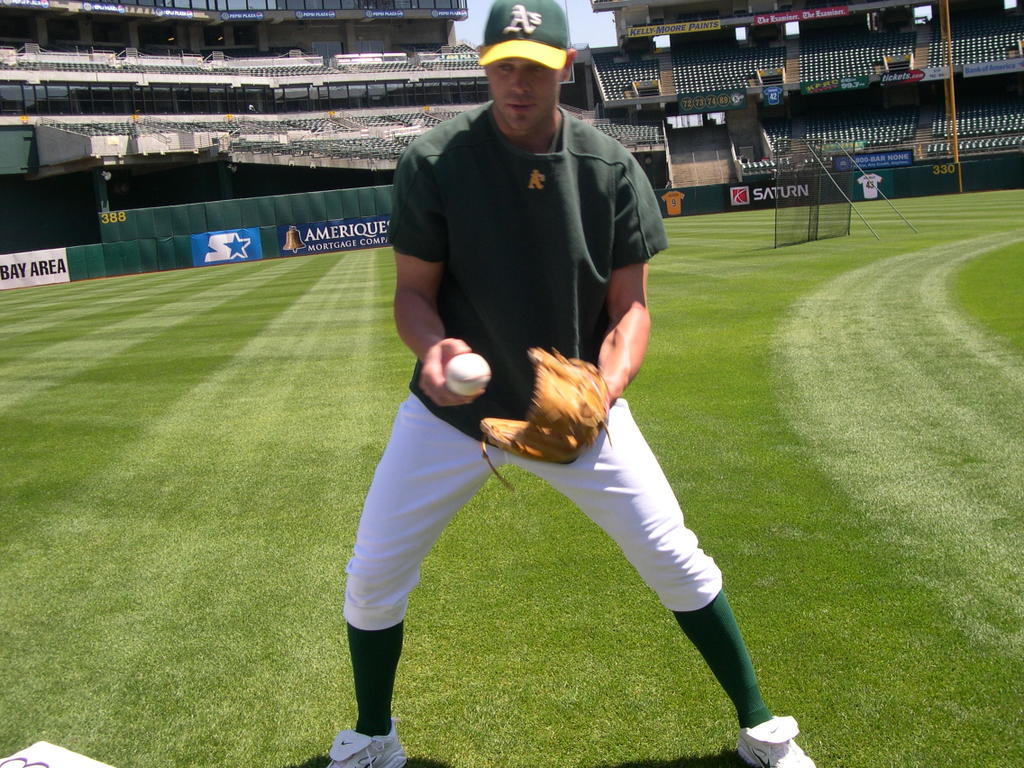 Bobby Crosby – I noted Bobby was tall and thin when I met him during the FanFest celebration earlier this year. He seems so serious, rarely cracking a smile. He showed us how to tackle the ball when it’s coming towards you, how he tries to get a jump on the ball when it’s coming off the bat: “I imagine a little circle in front of me. When the hitter is going through his swing, before the bat hits the ball, I lean into the circle.” His legs start to move and he can control in which direction he moves to field the ball. The worst baserunner to him is Ichiro “and believe it or not, Benjie Molina.” Ichiro is so fast that Bobby gunslings the ball in an overhead fashion, picking up the ball as quickly as he can to gun it to first. “Sometimes I don’t have a good grip but I’ve gotta make that throw.” Benjie is tough because he’s the slowest baserunner you’ve ever seen, “and frankly I just don’t know what to do with all that time! I find myself thinking, ‘You better get this throw right.'” Bobby told us that it was awesome playing next to Chavez, as he covers more territory than the average third baseman. Would you rather play with Scutaro or Ellis? He smirked slightly and diplomatically said, “It doesn’t matter. They both put it where I want it” on a double play. He told us he talks to Ellis when someone’s on base, whereas he pretty much directs Scutaro on how they’re going to play it.
Mark Kotsay – Kotsay, shorter than I imagined, with his sunglasses always on, treated us like a lecture hall. Fast-speaking and opinionated, he seemed very self assured. “I don’t care if you use one hand or two hands,” he started off, “just get it right. If you catch the ball with one hand, fine, but if you miss, maybe you should think about (using two hands).” He did say on this issue that one advantage of using both hands is, you can be ready to throw sooner, before the runner has two or three steps on you. He told us that the outfielders go over scouting reports, which he sometimes disagrees with, and he directs the other fielders where they’re placed. The center fielder, he said, can see the pitcher and the batter best, and can make adjustments faster. The worst park to play in, as far as outfielder Kotsay is concerned, is Angel stadium. “The walls come up too fast for me there.”
Jason Kendall – Jason had a stubbly beard and much to our surprise wore prescription glasses while he talked to us. His knuckles all seemed large and swollen, his fingers like they had each been broken at one time. He was the most glib of all the players, joked around with us a bit, and told some great stories. And talked baseball. “Chavvy and Kots will swing at anything and everything. So, if I’m the leadoff hitter, I try to give them a few extra pitches to look at. To tell you the truth, I’m more comfortable swinging with two strikes on me anyway.” He smiled conspiratorially and confided that he has a good relationship with all the umpires. “After 10 years, I’ve worked with them all.” He buys them beers whenever he gets a chance. He mentioned that all the young umpires are scared at the new Quest system, where an umpire review board sits in designated stadiums (like McAfee) and critiques the umpires. Old umpires like Joe West, however, are not scared. “’Hell, I’d like to see them do something to me,’” Kendall mimicked West, as he bought him another beer. And he’ll say things to “players I know, like Stairsy (Matt Stairs) the other day – ‘Oh, too bad you missed that pitch ‘cause it’s the last (fastball) you’ll ever see!'” Jason, who used to catch in the National League, seems to prefer that style of baseball, “it’s more of a game,” as the entire game is built around the pitcher. “The 8 and 9 hitters are so-so,” and the strategy revolves around them. Kendall told us that this year “is the most fun I have had in my career! Remember when we were struggling in April and May? The clubhouse was the same. It was the same.” Except that they were all trying to do too much. “I was swinging for the fences! I know I’m not a homerun hitter! I know what I can do and what I can’t do.”
The fans in our group were interesting themselves. We had the obligatory jerk, who insisted on asking most of the questions, and who liked, with each player, to sneak up on the player, throw his arm around him (without touching him) so that he could get a “chummy” photo with him. Sheesh. And we also had a Little League coach who would tell Bobby Crosby, for instance, what he was teaching his kids – “I tell them to throw low to the player” – only to be told by Bobby that they should throw high, “because most of those balls will skip by the kids.” The coach quickly changed the subject. But, in general, the group was a nice mixture of young and older, and we obviously shared one thing in common, our love of baseball and the Oakland A’s. I was amazed at how much each fan knew, not about baseball (that was for sure), but about the players.
After our hour or so of huddling with the players, we all gathered in line. The assistants handed each of us a new baseball and we could get it autographed by all five players. This was our last chance to say how much we appreciated the time they took for us, and to have a great season. I also took an extra minute to thank the original P.R. guy who took us onto the field.
As we left the field (with Rick muttering over and over, “I’m not going to leave. They can’t make me!”), I noticed Ron Washington giving some tips to some young ballplayer we didn’t recognize. He was obviously some rising young star who was taking infield practice. Wash would bat the ball to him and the young man would scoop it up in his glove. As Bobby Crosby told us, Wash is great with praise and never yells, and we watched that unfolding just a few feet from us as we approached the gate to go back up the stairs. Wash put the bat down, came toward the player and positioned his glove more correctly on the ground. “These are the details,” Rick said. We were watching, and earlier listening to, the difference between minor league and major league. It’s all in the details.
And so I never got my chance to throw the ball around with Bobby, or bat with Chavez. Thank God. What will I do with my $10 glove? I’ll keep it. Who knows, maybe I can get someone to play catch with me this weekend. Or maybe I’ll be picked for the Play Like a Pro next year? I could only hope.
Friday, August 19, 2005
Dogs, Frogs, and Baseball
The average age at the Oakland A's Booster luncheons is about 75. They seem to know each other, and they don't easily talk to interlopers. So I knew that, chances are if I went alone, I'd be sitting alone and talking to no one.
The 175 A's Boosters were lucky this time as Kirk Saarloos, a young pitcher and the Athletics' 5th in the rotation, screwed up with his alarm clock and was MIA when the session began. So they called Mark Kotsay, and the veteran outfielder showed up and answered questions for the group. But about an hour into the session, Kirk finally showed up, took a lot of razzing from his fellow ballplayer, and answered questions and even signed autographs for us.
During the dreaded chicken fried steak lunch, I ate in silence along with the rest of the fans at the table. One couple arrived late, however, and the gentleman seated next to me was fairly talkative. He told me I had something on the back of my A's shirt, and helped me brush it off. I mentioned something about "it's probably something from my dogs," and suddenly the 75-year-old ice queen sitting across from me started to melt...
"You have dogs?" she said, plaintively, looking up at me. "Yes," I said, and then I told her about Buddy and Chewy. "You have a chihuahua?" she said, not believing me. When I told her I had the most handsome chihuahua anyone had ever seen, her eyes teared up.
It seems that Cecilia had three chihuahuas, one at a time, over the years, but they have all passed on now. Her husband, Joe, then joined the conversation, and together, they told me stories of their dogs, how they looked, how they used to walk them on the street. They no longer have any dogs "'cause we travel too much," said Joe with a lilt in his voice. Joe then whipped out his wallet, and showed me two old and yellowing photos, one of a beautiful little, black, pudgy chihuahua and the other of their tan-colored one. Obviously devotion worked both ways in that family.
I told those at the table that I was going to undertake the Play Like a Pro clinic the next day. They all looked at me, staring a bit, until the woman off to the right -- she must've been at least 75 herself -- gave me some tips on how to throw to a catcher. I don't remember this tip, I must admit, but I thanked her for her assistance. She nodded approvingly. They all wished me luck.
Cecilia then told me that her 80-year-old sister, who recently moved in with them, just got an albino frog. "A what?" I said. "Yes, you heard right: a frog. My son gave her a frog. Hell, who do you think takes care of that thing? Me, not her. I will kill him the next time he tries to do something like that." This albino frog is a rare breed from Africa, and is a stunning gift, apparently, under most circumstances.
But a frog is not a dog. When Cecilia asked for my dog pictures, I reached for my wallet and discovered I had left the photos in my other wallet. She looked at me sternly. "You are coming to the next luncheon -- on September 28th -- and you are bringing photos." She was very serious.
As Robert Buan said goodbye to all of us at the Booster luncheon, Cecilia got in one more shot: "Remember to bring a photo of your chihuahua!" she said as I was slipping out the door of Francesco's. "Oh, and go A's!"
The 175 A's Boosters were lucky this time as Kirk Saarloos, a young pitcher and the Athletics' 5th in the rotation, screwed up with his alarm clock and was MIA when the session began. So they called Mark Kotsay, and the veteran outfielder showed up and answered questions for the group. But about an hour into the session, Kirk finally showed up, took a lot of razzing from his fellow ballplayer, and answered questions and even signed autographs for us.
During the dreaded chicken fried steak lunch, I ate in silence along with the rest of the fans at the table. One couple arrived late, however, and the gentleman seated next to me was fairly talkative. He told me I had something on the back of my A's shirt, and helped me brush it off. I mentioned something about "it's probably something from my dogs," and suddenly the 75-year-old ice queen sitting across from me started to melt...
"You have dogs?" she said, plaintively, looking up at me. "Yes," I said, and then I told her about Buddy and Chewy. "You have a chihuahua?" she said, not believing me. When I told her I had the most handsome chihuahua anyone had ever seen, her eyes teared up.
It seems that Cecilia had three chihuahuas, one at a time, over the years, but they have all passed on now. Her husband, Joe, then joined the conversation, and together, they told me stories of their dogs, how they looked, how they used to walk them on the street. They no longer have any dogs "'cause we travel too much," said Joe with a lilt in his voice. Joe then whipped out his wallet, and showed me two old and yellowing photos, one of a beautiful little, black, pudgy chihuahua and the other of their tan-colored one. Obviously devotion worked both ways in that family.
I told those at the table that I was going to undertake the Play Like a Pro clinic the next day. They all looked at me, staring a bit, until the woman off to the right -- she must've been at least 75 herself -- gave me some tips on how to throw to a catcher. I don't remember this tip, I must admit, but I thanked her for her assistance. She nodded approvingly. They all wished me luck.
Cecilia then told me that her 80-year-old sister, who recently moved in with them, just got an albino frog. "A what?" I said. "Yes, you heard right: a frog. My son gave her a frog. Hell, who do you think takes care of that thing? Me, not her. I will kill him the next time he tries to do something like that." This albino frog is a rare breed from Africa, and is a stunning gift, apparently, under most circumstances.
But a frog is not a dog. When Cecilia asked for my dog pictures, I reached for my wallet and discovered I had left the photos in my other wallet. She looked at me sternly. "You are coming to the next luncheon -- on September 28th -- and you are bringing photos." She was very serious.
As Robert Buan said goodbye to all of us at the Booster luncheon, Cecilia got in one more shot: "Remember to bring a photo of your chihuahua!" she said as I was slipping out the door of Francesco's. "Oh, and go A's!"
Monday, July 18, 2005
I walked a marathon at Disneyland's 50th Birthday
I have distinct memories of trips to Disneyland with my parents, and later my friends, starting in 1956. If you asked me how many times I have been to Disneyland, I couldn't tell you. I'm sure there was a visit to represent each decade. Even as I served in the Navy, transferred jobs, etc., there was always a visit to Disneyland that fit in between life events.
One of the most frightening memories I have of time spent at Disneyland was riding the donkeys through the Painted Desert when I was seven years old. Yes, that ride and that desert are gone now, and there's a good reason for the former. Those donkeys knew where the edge of the trail was, and where the cliff was, but as I leaned over in the saddle toward the edge of the narrow road, I was sure that I was going to plummet off the side of the burro into that chasm at any moment. My understanding is that the Disneyland donkeys were always sure on their feet but not as sure in controlling their impulse to bite the customers.
I also have uncomfortable memories of my brother twisting the center knob on the Alice in Wonderland Teacups in order to make it spin violently. I was terribly ill after that, and he looked quite pleased with himself.
But the Spaceship to Mars ride was the real reason I wanted to go to Disneyland. I saw it on the Sunday Disney T.V. show, and had to go there. I had to have my trip into space. I remember quite a few details about that first ride, as my father took me up the long staircase into the pod. I remember quite distinctly being aware that there weren't enough g's on the ride -- and this was at age 7 -- but not being terribly distraught about that fact.
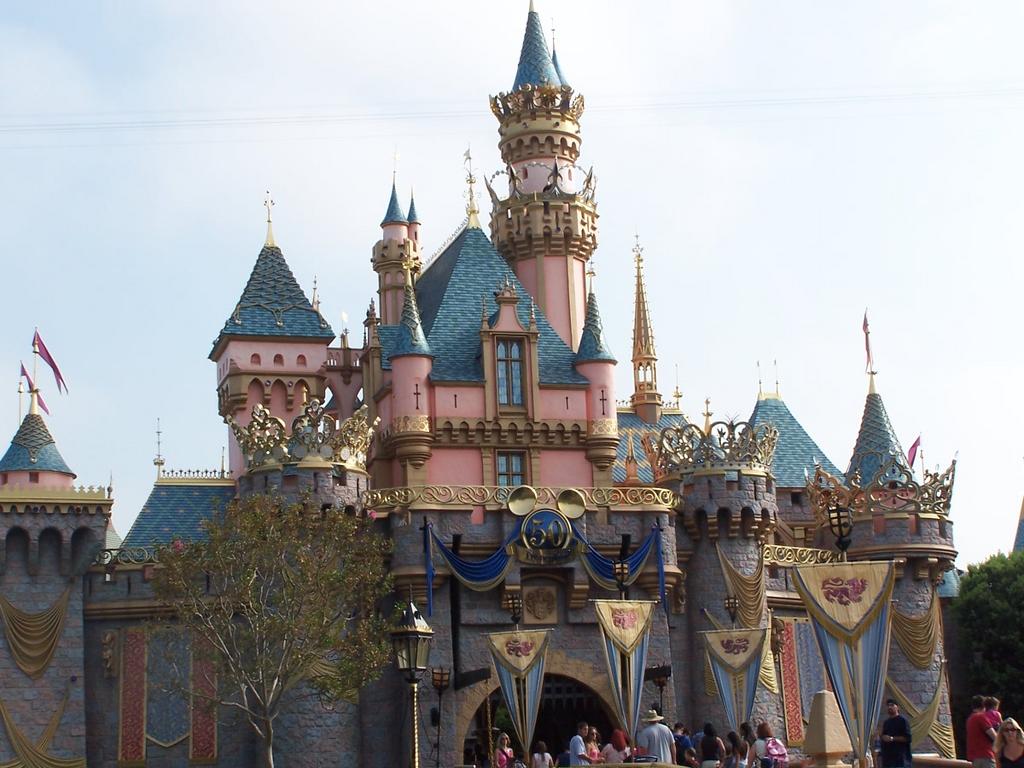
Our visit to Disneyland in 2005 commemorates the 50th anniversary of the park, and planning began about a year and a half ago. Plans have changed many times since then, and even a day before we left, but on Thursday evening, Brandon, Ricky and I drove from San Diego, where they lived, to Anaheim, and spent a night at the Worldmark resort in preparation for the trip.
Ricky, Brandon and I were joined by Joel, Rick's best friend, and Donald, Joel's friend, the next morning in the Disneyland parking building, and we transferred luggage to Joel's car, as we knew he'd be driving to the Desert Inn & Suites at 3 pm that day when we checked in the four guys. The Desert Inn was right across the street from Disneyland, right off Disneyland Way.
Friday, July 15th, we saw some unusually large crowds, many of whom were there for the Neil Armstrong Space Mountain dedication ceremony to be held at 10:00 am that day in Tomorrowland. Rick, Donald and I headed over to Tomorrowland, as we were very interested in seeing the former astronaut who made history with his one small step. Space Mountain was to be opened after being closed for over a year; it was to be transformed into a darker and smoother ride, a roller coaster in the dark.
However, we quickly discovered that they had moved the ceremony from the ground level to the rooftop of Space Mountain (and closed Space Mountain for the first few hours of the day). We couldn’t see anything from the ground level. And we couldn’t get up to the rooftop. Ricky and I suggested that Neil Armstrong's wish for privacy and security was at the root of this.
So, we went into the Innoventions exhibit, climbed the stairs to the 2nd level, and went outside from there. From there we could get a clean look at the festivities across the way. There were other fans there, gathering, but there were also huge camera set-ups, and within minutes, cast members were there to tell us we couldn’t stay there. They would not even allow us to stop on the ramp going down from that level. Since we couldn’t see anything clearly from any angle, we left Tomorrowland, which was growing denser by the minute. We grabbed a Fastpass for the new Buzz Lightyear game on the way out.
I rode Buzz Lightyear about six more times after that. While I really like the “ride,” where you shoot Zurg aliens (aiming for boxes with “Z”), I didn’t do well at all. The Disneyland ride seems to be a great improvement over the Disney World ride, as some of the targets are easier to see and you can raise your handheld blaster and point it wherever you want. It was proving to be a popular ride in Tomorrowland, but Fastpass (and the popularity of the newly opened Space Mountain ride) cut that wait quite a bit. I missed a few phone calls over the next few days on my cell phone, and found it hard to explain that I was shooting Emperor Zurg's robots in an important mission. "To infinity...and beyond!"
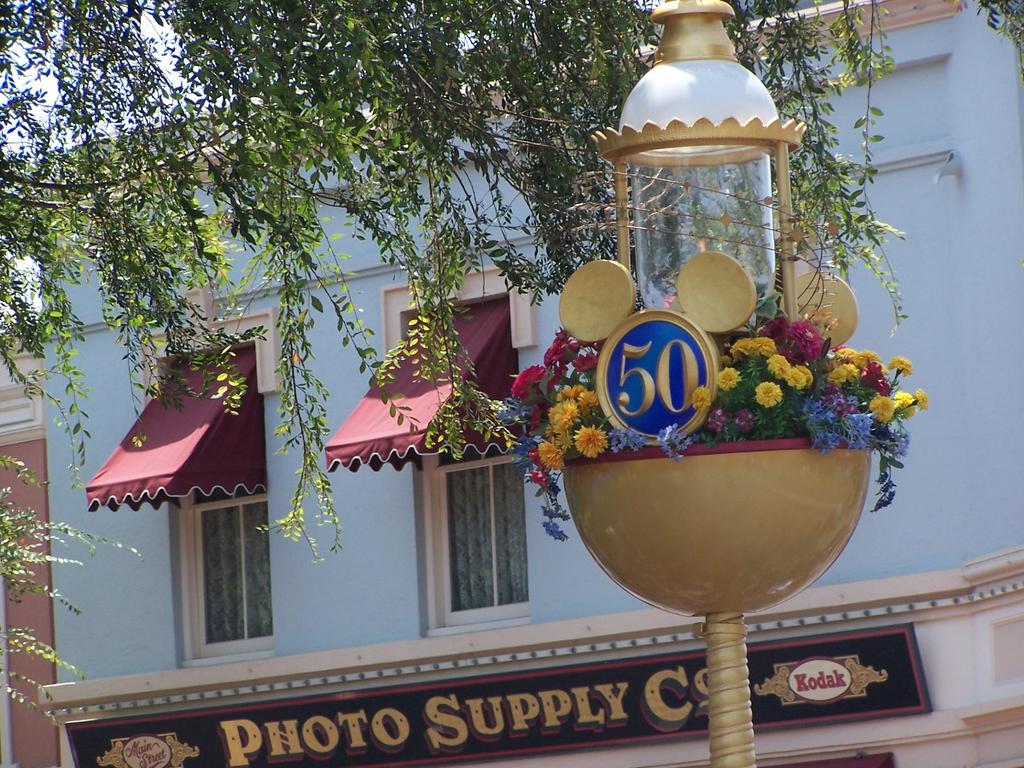 We spent the first day or so looking at what was different about Disneyland in an effort to commemorate the 50th Anniversary, including 50’s all around, lightposts with the gold 50, shopping bags and souvenirs with the 50th anniversary logo. Also, a very special treat: every original ride has a gold ride among them. For instance, the Autopia has a gold car, the railroad has a gold train, etc. So far we’ve accounted for 9 of the original 10, but haven’t spotted that gold train yet.
I made reservations for lunch and dinner for Friday and Saturday, believing that getting decent food in the parks would be difficult. Disneyland hamburgers are famous for their cardboard taste, and I have more expensive tastes these days. So, on Friday we ate lunch at the Blue Bayou, the best restaurant on the Disney grounds, located in New Orleans square overlooking the Pirates of the Caribbean ride (from the inside). All of us -- except for Joel, who, as usual, went for the kids' menu -- had the world-famous Monte Cristo sandwich. As Donald pointed out, when we asked him if he liked it, "I certainly should like something that's totally encased in fat." Oh, yeah.
Friday night we crossed over to the Dark Side and entered Disney's California Adventure. DCA has a terrible reputation with Disneyland fans, and for the most part, it's well earned. Never has so much real estate been devoted to so little. But I was willing to try its restaurants since I hadn't spent much time there. We had reservations at 6:30 pm at the Wine Country Trattoria, and after waiting some time in the heat, we were finally seated outside in pleasant surroundings. At the end of our meal, however, we all agred that the Trattoria has a limited menu with odd choices (lots of lasagna, for instance, but no spaghetti or other pasta), and terrible service.
Crowds were growing in the parks. Friday was manageable, Saturday approached about 100,000, and Sunday was expected to draw a capacity 112,000. Thank goodness it wasn’t terribly hot -- only in the low 80’s for the three days -- and thank extra goodness for DCA. The added park stretched the crowd out, especially during the Electrical Light Parade at night, held at 8:45 pm each night at DCA.

On Saturday morning we ran over to Space Mountain so that Donald and Joel could get a Fastpass. Unfortunately, on the second day of its opening, thousands of other people did the same thing. Whomever planned the exhibit, though, goofed and put the Fastpass booth in the same area as the initial boarding area, and the masses crowded in there, trying to find Fastpass. While Donald and Joel managed to score their Fastpass, it was a confusing mess. It turns out that most visitors really wanted to ride the re-opened Space Mountain, and within an hour, the Fastpass return time was pushed back to the evening.
On Saturday, the crowds were heavier but we could still cope with them if we pushed for our rides in the morning. By 11:00 am, the kids were beginning to arrive, though, and rides in the afternoon were difficult. Space Mountain was impossible. We had a pleasant lunch at the La Brea restaurant, right outside the gates in the beginning of Downtown Disney -- it was the first $11 BLT I’ve ever had, but it was delicious. And lots of peach tea. Dinner was at the Rainforest Cafe at the very end of DD. A long walk, but good food (also expensive). We shared a hot fudge Volcano at the end of our huge meal - whew!
On Sunday, July 17th and the actual birthday for Disneyland, everything changed. We had heard from various websites that they would be taking early arrivals between 2 am and 6 am and lining them up in Disneyland’s California Adventure. So Ricky, Donald and I agreed to meet at 5 am at the “O” in “California” at DCA. There was no way for me to get there by car or shuttle from my WM Resort, so I left my room at 4:30 am and walked 25 minutes down well-lit Harbor Blvd to Disneyland Drive. When I arrived, I couldn’t get to DCA at all, but I saw in the darkness that cast members were directing people to line up in the bus and shuttle parking lot. I got in line and then called Donald. They sent Brandon out to get me, and I happily discovered that they were about 200 people ahead of me, having arrived 20 minutes ahead of me.
We slowly went through security and they let us file into DCA, where they handed us our prized golden ears (with the date embroidered on the back) and a colored wristband, we walked and walked, trying to find the end of the long line. Finally we lined up and sat a little before Grizzly Rapids in DCA. We sat or stood there until about 7:20, when the line finally began to move in to Disneyland. We figured that about 10,000 of us early birds walked single file through a roped-off lane on the right into Disneyland, past the crowd who arrived after they capped the line. All the Disneyland cast members lined Main Street on each side as we entered the park, clapped for us, and shouted out, “Welcome home!” It was an unbelievable and moving experience.

Donald held out his hand and slapped the hands of cast members as he walked along Main Street towards the central hub. I merely looked at the cast members, thanked them, and took photos as I blinked back tears.
Ricky immediately went to the stage at the hub where the statues of Walt and Mickey are to see if there was any way we could stand to watch the ceremony live. The large speaker and screen blocked the view of the castle from almost any vantage point. It took a few minutes for him to determine that there was no chance to see the ceremony live, as about 4,000 people had gotten into Disneyland ahead of us, and many of them had the same thing in mind.
While he was doing that, I ran off to try to make lunch reservations. I got to the Carnation Cafe, and they said they were not taking reservations but that we could come back and stand in line. I ran over amidst thousands of early arrivals to the Blue Bayou in New Orleans Square, only to find that all the priority seating was gone until 4 pm -- since they weren’t taking any P.S.’s over the phone in advance, that meant that early arrivals booked all the P.S.’s in the hour before I arrived. I noticed a big, long line snaking around the river and asked a cast member what that was all about. “This is the line for exclusive merchandise, offered only today.” Oooh, I thought, but took one look at the growing line and decided it would be much like Celebration 3. I went back and rejoined Ricky and Donald at the hub/stage area.
Ricky went to the nearby Carnation bakery and got us the free cupcakes Disneyland promised. The cupcakes, of course, were the "birthday cake," a gift from Disneyland to all us, and available that day only in places that sold food in the park.
While we waited, we enjoyed the "Ken" show while I avoided people stepping on me in the roped off area (roped off soon after we planted ourselves there). Ken was a cast member who had the unfortunate duty of telling people they couldn't sit on the benches at the hub or even walk through there, as it was a VIP and Media gathering area. He used all of his skills as hundreds of people tried to sneak in, or yell at him to get in, or do anything they could, all to no avail. One of the people in our roped-off section said, "Hey, I know you! You're from the Tower of Terror!" Ken grinned, and responded that they all were, and pointed out the other Tower of Terror cast members who had been drawn over to work at this big event. "Who's over at Tower today? Nobody," he shrugged.
The show was brief and very nice. Art Linkletter, who hosted the original opening of Disneyland, appeared and kicked things off. Today was also HIS birthday!!! At 93, he was as quick-thinking and witty as ever, and had a ton of stories to tell. But he only told a few and introduced the two Disney CEO's, Iger and Eisner. Then California Governor Arnold Schwarzenegger came out of the castle with Mickey, and said a few words about Disneyland helping the economy and creating jobs. Then, the piece de resistance appeared in the form of Walt Disney's daughter, Diane Disney Miller, who told us how Disneyland was created ("Dad reserved Saturday mornings, just for us kids, and would go to parks with us, sit on the bench and eat peanuts"). We really enjoyed hearing her talk.
After the ceremony, the crowd moved, slowly, towards the rides. I and my crew, however, went towards the Carnation Cafe. They were starving, as they were looking forward to their first meal of the day. We dutifully stood in line at Carnation, and I was pleased to see that it only took 50 minutes to get in. In the meantime, Joel had caught up with us and Ricky found Brandon over by the Star Tours meeting place.
Donald, Ricky, Joel and Brandon agreed to meet at their motel at 2:30 so they could drive home to San Diego. In the meantime, however, Ricky, Donald and I went over to the old Mr. Lincoln spot, and watched the Steve Martin/Donald Duck movie of how Disneyland was created. We also looked at the actual props and drawings for the park in the waiting area.
On the way out of the park, I grabbed several of the Disneyland programs, as this version was only printed on the Disneyland birthday, July 17th. I hugged everybody and waved goodbye, and headed over to DCA for one last look. I watched the Aladdin play live, a 45-minute show, and marvelled at it, but found myself falling asleep. But one last look at Crush, the talking sea turtle -- amazing interaction with the audience!! -- and I knew I had had enough. I went back to the WM resort on the van, and fell asleep at 6:30 pm, and wouldn't wake up until Monday morning.
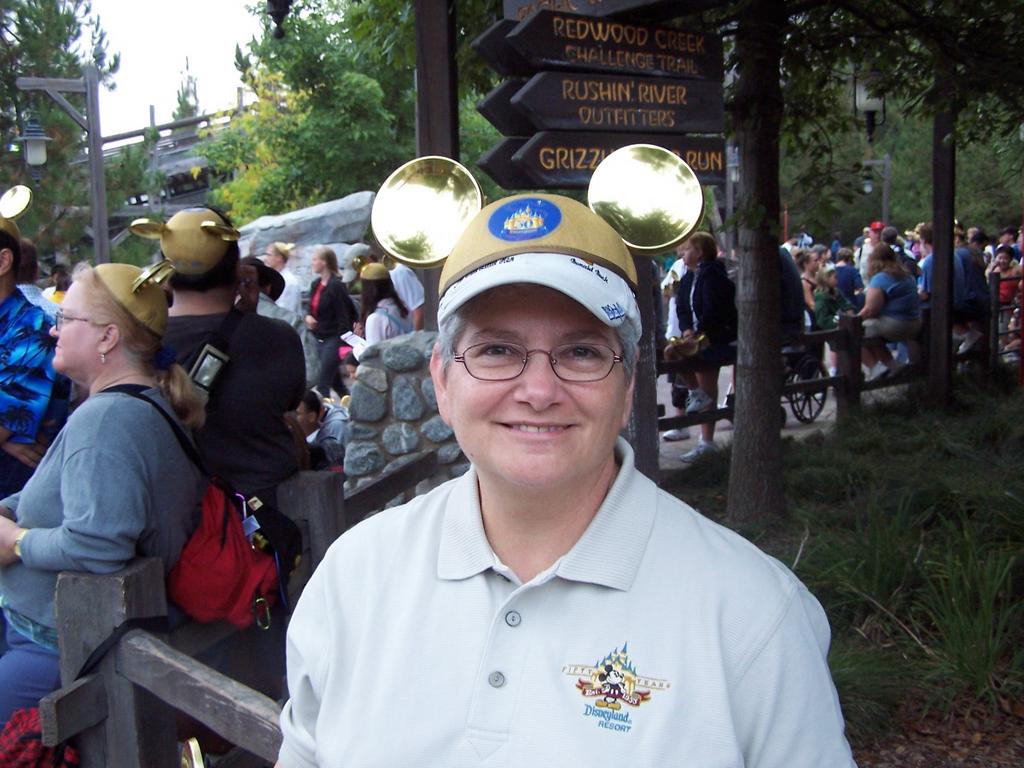 Thank goodness for cell phones, or we would never have found each other over the three days. However, it was difficult keeping track of Brandon, our teenager who turned 16 in Disneyland on Saturday. I found myself wishing for an arm implant with a tracking device for him. He disappeared at least twice a day, and I wondered if we would ever see him again. We would quiz him on where to meet, where the hotel was, just so he would have a reference point if he found himself alone.
And I needn't have worried about keeping up with my exercise during this vacation. My pedometer showed me I walked, we walked, 4 to 9 miles a day. The most was on Saturday, which was an exhausting day of running from place to place. Sunday was exhausting just because of the hour at which we had to be there. This was not the time to see Disneyland to see rides. This was the time to visit Disneyland to celebrate its birthday. It's amazing to think I was there, 49 years ago, with my mother and father. I rode the Spaceship to Mars rocket, my dream come true, along with other rides that are no longer there. So many years later, I realized another dream as I visited with the next generation of my family. As the cast member told me on my entrance on Sunday, I had come home.
Wednesday, July 13, 2005
My Dream Vacation, Part 5: Villa Pisani and the Beach Boys
"Are you awake?" Val whispered to me at 11:30 pm. We were both lying there in the dark in our room at the Villa Pisani, listening to the dum, dum, dum of the bassline.
I said, "Sure." "Do you hear that music? What are they playing?" she continued.
"'California Girls,' I replied, absent-mindedly, since I'd been following the band over the last two hours. "'The midwest farmer's daughters really make you feel all right, and the northern girls...' I sang along.
"You hear words? I don't hear words." I could barely hear the singer, hearing instead the booming of the bass along with the upper-register twang of a guitar. But I knew all the songs. It was an Italian band doing really poor cover versions of songs from the '60's.
"You'd think Madame Scalabrin would have told us she had a party scheduled for tonight."
Indeed. But the maintenance on a huge villa dating back to the 16th century must cost a fortune every month. I was sure she was booking anything and everything she could to stay afloat. After all, that's how we became guests at a real Italian villa.
We found Villa Pisani in Vescovana, a hamlet 30 minutes south of Padua, after driving up and down highway 4 for half an hour. When we knew we were close, Val popped into a bar, and in her improving Italian, asked the bartender where the Villa Pisani was. He pointed up the road. We drove about three blocks but found nothing. We noticed that the numbers on the building, however, were getting larger, so we turned around. There was the bartender, standing outside his doorway, pointing next door. I think he was laughing...
Mariella Bolognesi Scalabrin met us at the huge gate, and welcomed us warmly. Without much fanfare or introduction to the huge estate, she showed us quickly under the grape-vined trellis of the patio to our room, which was on the 2nd level off to one side of the much larger and cooler salon.
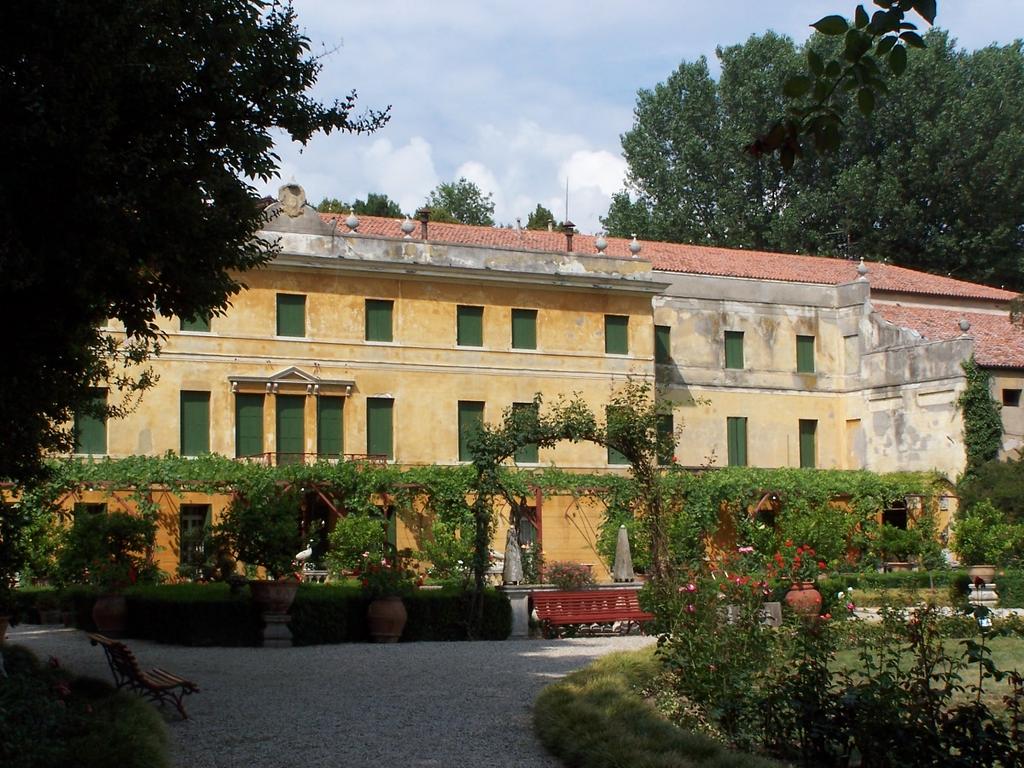
The building was constructed in 1468, and went through several families over the centuries. When Evelina van Millingen took up residence in 1852, having married Almoro III Pisani, the last descendant of the Santo Stefano Pisani family, she transformed the villa into a showpiece by transforming the garden to a proper English garden. Evelina's villa became the base for American artists and royal visitors, among them Henry James, the Queen of Sweden, the Empress of Germany, the daughter of Queen Victoria (Frederica), Robert Browning and Lord Byron.
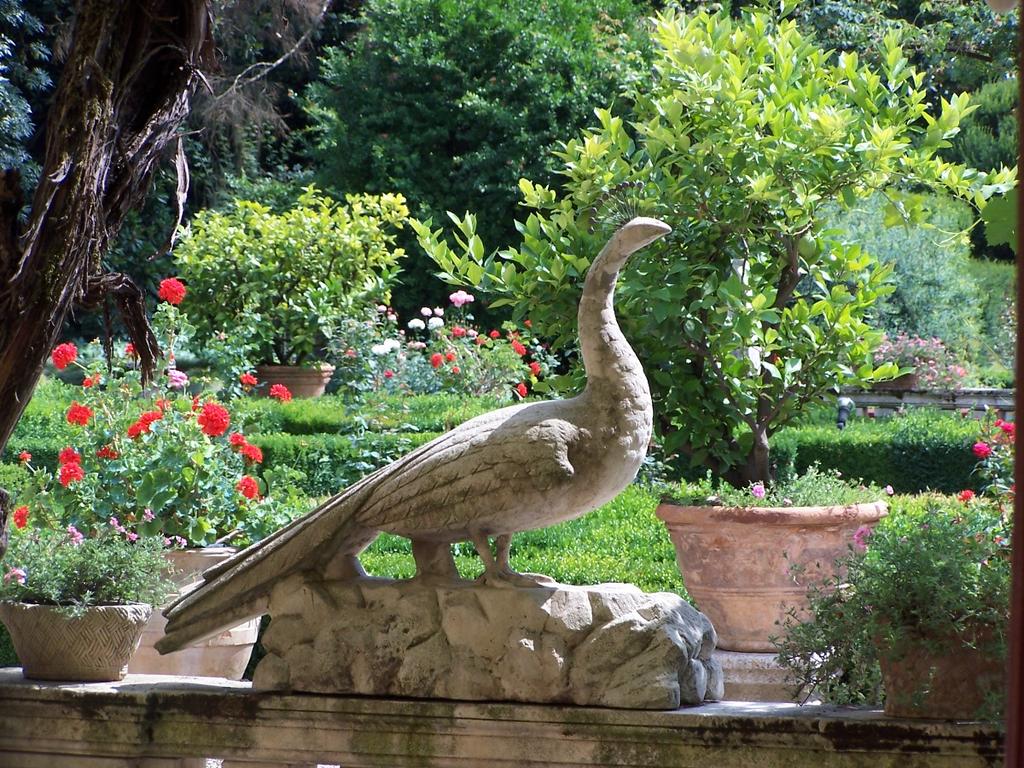
The garden is Victorian in taste and features a large formal garden with sculptures and boxwood hedges. The garden was reportedly inspired by "The Formal Garden in England," a book published in 1892 by Sir Reginald Blomfield. The park has centuries-old trees, old and knotted rose bushes, clipped hedges forming geometric designs, statues, fountains, a pool house, rock garden and family theater and chapel. It's a beautiful way to spend an evening.

The villa itself seems to stretch for blocks along the garden, and has an endless number of antique- and frescoe-filled rooms blending one into the other. Even our "simple" bedroom was adorned with antiques. The bed was new and comfortable, and a wooden addition within the room provided us with closet space and a small but adequate bathroom and shower. I felt like I was staying in a museum, but the only inconvenience I felt was the lack of air conditioning on a hot day.
We took our afternoon activities into the salon while waiting for the room to cool off. We sat on the cool tiled floor and played gin rummy while observing through the large open window the arrival of guests. We could also hear tables being set up nearby. Obviously there was going to be some sort of celebration tonight, but we weren't invited.
The next morning we went downstairs, and were greeted again by Madame Scalabrin, who showed us to the breakfast room. "We would normally eat outside," she apologized, "but it's so cold this morning." Cold meant that it was in the low 60's. Two menopausal women were thankful for that kind of chill.
We ate breakfast, just the two of us, in silence as we took in another breaktaking old room, filled with several sets of silver tea service and china that had obviously been in the family for many years. Breakfast was rather simple: cheese, mueslix with milk, yogurt, tea and coffee.
After breakfast, I loaded up the car with our bags while Val continued to talk with Madame Scalabrin. She related later that she told her the Villa Pisani website was lovely but lacking in information, particularly an adequate description of how charming her home was. Mrs. Scalabrin was delighted to see some of the digital photos in Val's camera and seemed to enjoy hearing that here was someone who could help advertise her home for future guests. Val left her after promising to write some copy about the estate in the near future, to be emailed directly to her.
I guess I don't have to tell you that the copy advertising the magnificent Villa Pisani will leave out the part about the Beach Boys...
Tuesday, July 12, 2005
My Dream Vacation, Part 4: Driving in the Bermuda Triangle
I had some nightmares about driving in a foreign country, particularly Italy. After all, during my first visit, our tour bus driver told us (as translated), "Red lights are merely a suggestion for driving in Italy."
So, it was with great trepidation (which I didn't hide very well from my traveling companion) that I approached the rental car counter as we left Firenze. Our scheme was to rent the car on our way OUT of Florence so that we didn't have to bother with driving around the big city. Florence is a walking city anyway, and that would've seemed a waste. However, the problem with renting a car IN the big city is that you have to drive the car OUT of the big city.
So, with all of that in the back of my rather negative attitude, we were waiting for the taxi outside the Hotel Adler Cavelieri at 10 o'clock that morning after 5 days in glorious Firenze, I twiddled with the rental car voucher....and just happened to notice that the dates we were to rent the car were all wrong. The travel agent had booked us to rent the car on the day we arrived in Florence, which was, of course, incorrect. We were screwed before we even started.
We both agreed that the best way to approach the rental car agency, Europcar -- a name which would subsequently produce terror -- was to allow them to tell us we screwed up. And they did. "You do not have a car, madame," said the very polite man at the reservations desk. After much fiddling and conversation between Val and the reservationist, he produced a car some 45 minutes later. As we were about to climb into the car, we noticed it was a stick shift. We politely informed him that we booked an automatic, and that we cannot drive a stick shift. He looked perplexed. This appeared to be a very grave problem.
It seemed that the only thing that could be done was to contact the U.S. Europcar agent, and begin the rental process all over. So, he dialed the phone, explained the problem in English to the person on the line, and handed the handset to Val. She did her best to explain the problem. The U.S. office promised to fax a voucher to Europcar in Florence immediately.
It turns out that "immediately" in the U.S. has the same meaning as "immediately" in Italy, at least in this case. Five hours later, we were still in the little cramped, non-airconditioned office. Val had the extremely bright idea to stay put in the office in the single chair provided patrons, so that when the staff went to lunch they would look at us and feel guilty. While I don't know if that scheme worked, something happened very soon after they returned from a rather lengthy lunch. Even though they had called three times for us, the voucher still had not arrived. However, one woman who took over for our reservationist suddenly said, "Madame, I have a car for you," even without the required voucher. She explained that it was a larger, more expensive car, but it was an automatic and air-conditioned. We mentally leaped for joy, and thanked the entire staff for their kindness.
The Mercedes was a 220, a shiny black testament to fine workmanship. Val sat in the driver's seat, and I surrounded myself with all kinds of city maps in the passenger's seat, and, with directions on how to get out of Dodge firmly in hand, we set off...
And immediately found ourselves in a speedy, rolling quagmire. We were in the steets of Florence, going this way, going that, and the map seemed to make no sense at all. After we crossed the Arno, I said, "I don't think we should be crossing the Arno," but Val took a right turn at the next bridge and all was well. When we passed the last Firenze sign (with a line through it), we breathed a sigh of relief. We blissfully had no idea that things would go downhill from there.
We selected the smaller roads rather than the auto strade because we wanted to enjoy the countryside during our journey. However, the SS road took us up into the mountains along a narrow, winding path, an effort that made me car sick the entire trip and that proved to be an intense effort for the driver. We did see some marvelous terrain when we reached the top, stopping at a local bar. The locals sat in the bar, watching us as we walked in looking for toilets and maps. We figured out quickly that tourists don't normally come through these little towns, even in the middle of the summer.
It took us 4 hours to reach Forli, the last big city before we would drive into Ravenna, and we knew the mappy.com directions wouldn't be good enough. So we pulled into a little gas station and looked for a better map. Val looked in her little Italian phrase book the word for "map", and tried using her limited vocabulary on the gas station attendant. He spoke no English, but tried to be as helpful as possible while gently correcting her Italian. We found the city map of Ravenna and headed off, knowing that in one hour we would be in that magical city.
As the navigator, it's my duty to assure the driver that (1) we're not lost, (2) I know exactly where we are, and (3) we'd be in town, safely ensconced in our hotel before dinner. Numbers 1 through 3 flew out the window quickly. As soon as we hit the borders of Ravenna, I was quite aware that we were very lost. I couldn't find a single street on the map, as I tried to make out hidden street signs that flew past the window. We finally gave up in frustration and headed for the city centre.
The city centre isn't large in Ravenna, but it's laid out in a fashion that defies logic. There is no grid, just winding streets that may have three names within one block. We could not find the hotel, Albergo Cappello on Quattro (IV) Novembre Street. After an hour of driving around, knowing we were late to begin with and fearing we could not check in if we were any later, we decided to just park the car in the John Kennedy Piazza (at least we'd remember the name), and hoof it from there.
Once we got out of the car, finding steet names was slightly easier, and with Val's map skills we found the hotel, which, as it turned out, was only about two blocks away.
The Albergo Cappello is located off a piazza where there is no parking. Guests are told to "park anywhere, there is ample parking close by," but fail to tell you that all streetside parking has a limit. However, the next morning as we re-parked, we followed some "P" signs and happened upon a garage. The large, gruff Italian man in charge seemed to understand what we wanted, and with Val's limited Italian, we understood that we booked lodging for our car.
Off to the side while they were talking I noted a cocker spaniel. He was asleep when we parked, but came awake and sauntered over to sniff the tires of the car, not us. Then he leisurely went back to his place in the stoop of the apartment a few feet away, and drifted back to sleep.
The Albergo Cappello is a delightful hotel in a terrific location (if you don't have a car) in the middle of town. There are plenty of restaurants and bars around, and the local sights are just a few blocks away. We had to locate the hotel clerk, as reception was empty, but we found her quickly enough in the bar down below. She was very friendly as she took us to the elevator to show us our room. However, once we got off the elevator, we immediately discovered another flight of marble stairs had to be climbed to reach the room. I was beginning to realize that almost all hotels in Italy involve stairs.
Our room was larger than the usual European hotel room (or a Motel 6, for that matter), with wonderful windows that let in the light. The air conditioning was termpermental, but we finally figured it out enough to coax a little cold air. The bathroom, while not as grand as the Adler's, was quite nice, and featured a large tub with adjustable shower nozzle.
The hotel has only 7 rooms, 7 rooms in an older building but with modern conveniences. The hotel is attached to the old medieval tower, which we could see from our window. The hotel featured a large reception room which offered a breakfast nook and many magazines and brochures about Ravenna.
But we were here to see Ravenna, specifically the old cathedral, the mausoleum and the baptistery. Val was quite focused, once we reached town, as she wrote her Master's Thesis at the University of Chicago on the medieval baptistery. She could see it in her mind but she'd never been there. As she was to discover in an emotional wakening upon walking into first the cathedral and then the baptistery, seeing photos in a book is not the same as being there.
And so it was an exciting moment to watch as we climbed the stairs that lowered us into the San Vitale cathedral. I was immediately struck by the fact that very few tourists were there. (Actually, there weren't any tourists at all in town. No, that's wrong -- it's just that most of the "tourists" were Italian. Very few Americans, it would seem, traveled to Ravenna.) The cathedral looked enormous and stark even though it was one of the smaller ones I had seen this trip, but the visitor is immediately drawn to the delicately formed mosaics which have made this region famous. The last supper in the dome was an amazing sight; it's hard to realize that workers spent their whole lives putting these mosaics together.
The mausoleum was located in the courtyard just outside the cathedral. This building is amazing, and its mosaics are just as powerful. Only a few are buried here, which means it's a building not used much, a fact which has helped preserve its art. When I entered, I noticed how dark inside it was and slightly claustrophobic -- I did not have to bend to enter, but I noticed how small the doorway was, a testament, I supposed, to smaller men in the 13th century.
After we exited the site of these two buildings, we found ourselves back down winding streets and came face-to-face with the baptistery. Or at least Val did, as she recognized the nondescript, octagonal stone building immediately. "This is it," she said softly, and we entered the lone doorway quietly.
The magnificence of the Neonian baptistery isn't immediately evident until you look at the details. Remember the adult men entering the baptistery once a year? The same rules apply here, and as they sink into the baptismal waters, they stare above to the ceiling and see a naked mosaic Christ being baptised in the River Jordan. When they rise again slowly to answer the bishop's questions, they would see his head surrounded by a large ring, almost a halo, painted onto the wall in back of the font. Gold and blues glitter as the light hits the mosaic stones. It is truly unbelievable to behold and find yourself wondering how the ritual went so many years ago.
We left Ravenna after two nights, after having seen those three magnificent examples of architecture and religiious belief in the Dark Ages. (The cathedral had been brought "up to date" in the Renaissance, with ungainly but modern paintings having been added in the blank spaces of the ceiling.) We agreed that we would take the auto strada to get out of town. Surely getting out of town wouldn't be as bad and lengthy as getting in?
It almost was, as we found ourselves having to turn contrary to the map. But we got back on the right road, and drove up to the ticket booth to begin the auto strade.
Except that I couldn't figure out what to do at the ticket booth. I couldn't pay money, it wouldn't allow for it. Finally the light went on and Val said, "Oh, we just take the ticket!" We then figured out that when we exit the auto strade, we punch the ticket, and the machine will tell us how much to pay according to how far we've traveled. Ingenious.
We hit the auto strade with renewed enthusiasm for our trip, having just witnessed what few have ever seen in Ravenna, and with a firm belief that "we can do this!" And driving on the auto strade in a straight line seemed a lot easier than finding your way in a little town. We decided that I would drive, for the most part, while Val navigated. The division of labor would save us, we were certain.
The auto strade usually has three lanes of varying speeds:
The right lane: Go the speed limit.
The middle lane: Go slightly above the speed limit.
The left lane: What speed limit?
I discovered almost immediately that if I stuck a toe into the faster lane, I would find a car driving up my butt, coming out of nowhere at tremendous speeds. So I learned to first, decide if I really do want to get into that other lane, and then, secondly, pull the wheel sharply and go like hell until I could get over into the right lane again. When that other car narrowly misses you because you're too slow, and you see the Renault's bumper just inches away from your own, you try not to take it personally. They don't. It's just driving.
So we escaped the Bermuda Triangle of Ravenna only to find ourselves in another of Dante's rings of Purgatory, the speedy auto strade.
So, it was with great trepidation (which I didn't hide very well from my traveling companion) that I approached the rental car counter as we left Firenze. Our scheme was to rent the car on our way OUT of Florence so that we didn't have to bother with driving around the big city. Florence is a walking city anyway, and that would've seemed a waste. However, the problem with renting a car IN the big city is that you have to drive the car OUT of the big city.
So, with all of that in the back of my rather negative attitude, we were waiting for the taxi outside the Hotel Adler Cavelieri at 10 o'clock that morning after 5 days in glorious Firenze, I twiddled with the rental car voucher....and just happened to notice that the dates we were to rent the car were all wrong. The travel agent had booked us to rent the car on the day we arrived in Florence, which was, of course, incorrect. We were screwed before we even started.
We both agreed that the best way to approach the rental car agency, Europcar -- a name which would subsequently produce terror -- was to allow them to tell us we screwed up. And they did. "You do not have a car, madame," said the very polite man at the reservations desk. After much fiddling and conversation between Val and the reservationist, he produced a car some 45 minutes later. As we were about to climb into the car, we noticed it was a stick shift. We politely informed him that we booked an automatic, and that we cannot drive a stick shift. He looked perplexed. This appeared to be a very grave problem.
It seemed that the only thing that could be done was to contact the U.S. Europcar agent, and begin the rental process all over. So, he dialed the phone, explained the problem in English to the person on the line, and handed the handset to Val. She did her best to explain the problem. The U.S. office promised to fax a voucher to Europcar in Florence immediately.
It turns out that "immediately" in the U.S. has the same meaning as "immediately" in Italy, at least in this case. Five hours later, we were still in the little cramped, non-airconditioned office. Val had the extremely bright idea to stay put in the office in the single chair provided patrons, so that when the staff went to lunch they would look at us and feel guilty. While I don't know if that scheme worked, something happened very soon after they returned from a rather lengthy lunch. Even though they had called three times for us, the voucher still had not arrived. However, one woman who took over for our reservationist suddenly said, "Madame, I have a car for you," even without the required voucher. She explained that it was a larger, more expensive car, but it was an automatic and air-conditioned. We mentally leaped for joy, and thanked the entire staff for their kindness.
The Mercedes was a 220, a shiny black testament to fine workmanship. Val sat in the driver's seat, and I surrounded myself with all kinds of city maps in the passenger's seat, and, with directions on how to get out of Dodge firmly in hand, we set off...
And immediately found ourselves in a speedy, rolling quagmire. We were in the steets of Florence, going this way, going that, and the map seemed to make no sense at all. After we crossed the Arno, I said, "I don't think we should be crossing the Arno," but Val took a right turn at the next bridge and all was well. When we passed the last Firenze sign (with a line through it), we breathed a sigh of relief. We blissfully had no idea that things would go downhill from there.
We selected the smaller roads rather than the auto strade because we wanted to enjoy the countryside during our journey. However, the SS road took us up into the mountains along a narrow, winding path, an effort that made me car sick the entire trip and that proved to be an intense effort for the driver.
 We did see some marvelous terrain when we reached the top, stopping at a local bar. The locals sat in the bar, watching us as we walked in looking for toilets and maps. We figured out quickly that tourists don't normally come through these little towns, even in the middle of the summer.
It took us 4 hours to reach Forli, the last big city before we would drive into Ravenna, and we knew the mappy.com directions wouldn't be good enough. So we pulled into a little gas station and looked for a better map. Val looked in her little Italian phrase book the word for "map", and tried using her limited vocabulary on the gas station attendant. He spoke no English, but tried to be as helpful as possible while gently correcting her Italian. We found the city map of Ravenna and headed off, knowing that in one hour we would be in that magical city.
As the navigator, it's my duty to assure the driver that (1) we're not lost, (2) I know exactly where we are, and (3) we'd be in town, safely ensconced in our hotel before dinner. Numbers 1 through 3 flew out the window quickly. As soon as we hit the borders of Ravenna, I was quite aware that we were very lost. I couldn't find a single street on the map, as I tried to make out hidden street signs that flew past the window. We finally gave up in frustration and headed for the city centre.
The city centre isn't large in Ravenna, but it's laid out in a fashion that defies logic. There is no grid, just winding streets that may have three names within one block. We could not find the hotel, Albergo Cappello on Quattro (IV) Novembre Street. After an hour of driving around, knowing we were late to begin with and fearing we could not check in if we were any later, we decided to just park the car in the John Kennedy Piazza (at least we'd remember the name), and hoof it from there.
Once we got out of the car, finding steet names was slightly easier, and with Val's map skills we found the hotel, which, as it turned out, was only about two blocks away.
The Albergo Cappello is located off a piazza where there is no parking. Guests are told to "park anywhere, there is ample parking close by," but fail to tell you that all streetside parking has a limit. However, the next morning as we re-parked, we followed some "P" signs and happened upon a garage. The large, gruff Italian man in charge seemed to understand what we wanted, and with Val's limited Italian, we understood that we booked lodging for our car.
Off to the side while they were talking I noted a cocker spaniel. He was asleep when we parked, but came awake and sauntered over to sniff the tires of the car, not us. Then he leisurely went back to his place in the stoop of the apartment a few feet away, and drifted back to sleep.
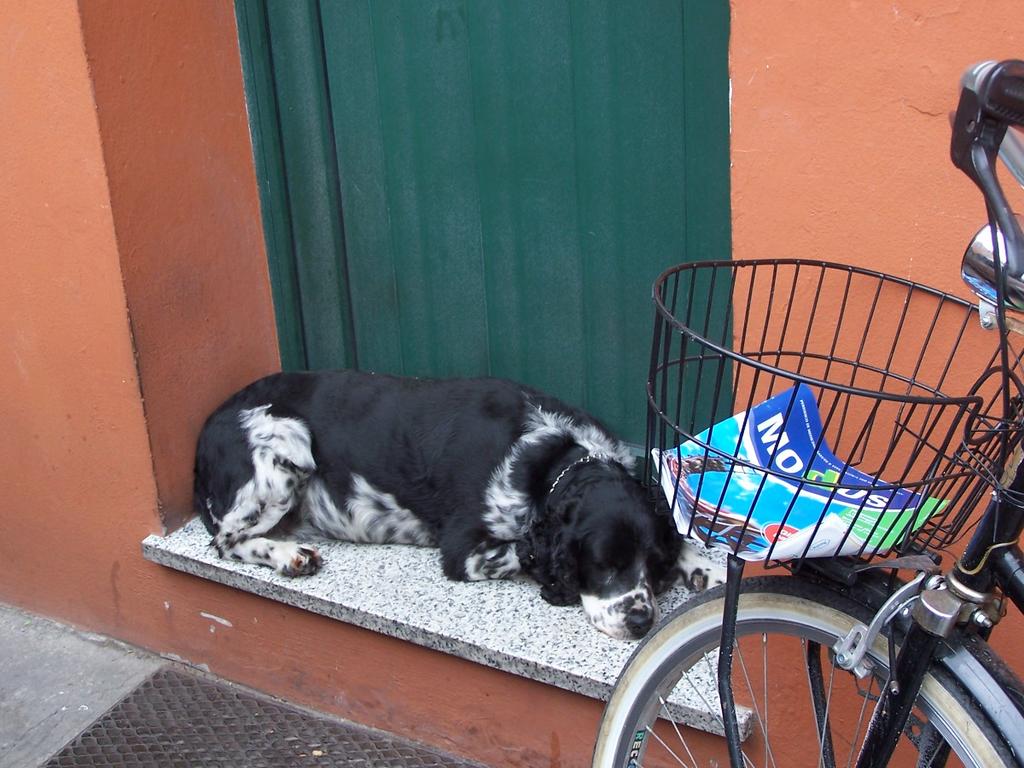
The Albergo Cappello is a delightful hotel in a terrific location (if you don't have a car) in the middle of town. There are plenty of restaurants and bars around, and the local sights are just a few blocks away. We had to locate the hotel clerk, as reception was empty, but we found her quickly enough in the bar down below. She was very friendly as she took us to the elevator to show us our room. However, once we got off the elevator, we immediately discovered another flight of marble stairs had to be climbed to reach the room. I was beginning to realize that almost all hotels in Italy involve stairs.
Our room was larger than the usual European hotel room (or a Motel 6, for that matter), with wonderful windows that let in the light. The air conditioning was termpermental, but we finally figured it out enough to coax a little cold air. The bathroom, while not as grand as the Adler's, was quite nice, and featured a large tub with adjustable shower nozzle.
The hotel has only 7 rooms, 7 rooms in an older building but with modern conveniences. The hotel is attached to the old medieval tower, which we could see from our window. The hotel featured a large reception room which offered a breakfast nook and many magazines and brochures about Ravenna.
But we were here to see Ravenna, specifically the old cathedral, the mausoleum and the baptistery. Val was quite focused, once we reached town, as she wrote her Master's Thesis at the University of Chicago on the medieval baptistery. She could see it in her mind but she'd never been there. As she was to discover in an emotional wakening upon walking into first the cathedral and then the baptistery, seeing photos in a book is not the same as being there.
And so it was an exciting moment to watch as we climbed the stairs that lowered us into the San Vitale cathedral. I was immediately struck by the fact that very few tourists were there. (Actually, there weren't any tourists at all in town. No, that's wrong -- it's just that most of the "tourists" were Italian. Very few Americans, it would seem, traveled to Ravenna.)
 The cathedral looked enormous and stark even though it was one of the smaller ones I had seen this trip, but the visitor is immediately drawn to the delicately formed mosaics which have made this region famous. The last supper in the dome was an amazing sight; it's hard to realize that workers spent their whole lives putting these mosaics together.
The mausoleum was located in the courtyard just outside the cathedral. This building is amazing, and its mosaics are just as powerful. Only a few are buried here, which means it's a building not used much, a fact which has helped preserve its art. When I entered, I noticed how dark inside it was and slightly claustrophobic -- I did not have to bend to enter, but I noticed how small the doorway was, a testament, I supposed, to smaller men in the 13th century.
After we exited the site of these two buildings, we found ourselves back down winding streets and came face-to-face with the baptistery. Or at least Val did, as she recognized the nondescript, octagonal stone building immediately. "This is it," she said softly, and we entered the lone doorway quietly.
The magnificence of the Neonian baptistery isn't immediately evident until you look at the details. Remember the adult men entering the baptistery once a year? The same rules apply here, and as they sink into the baptismal waters, they stare above to the ceiling and see a naked mosaic Christ being baptised in the River Jordan.
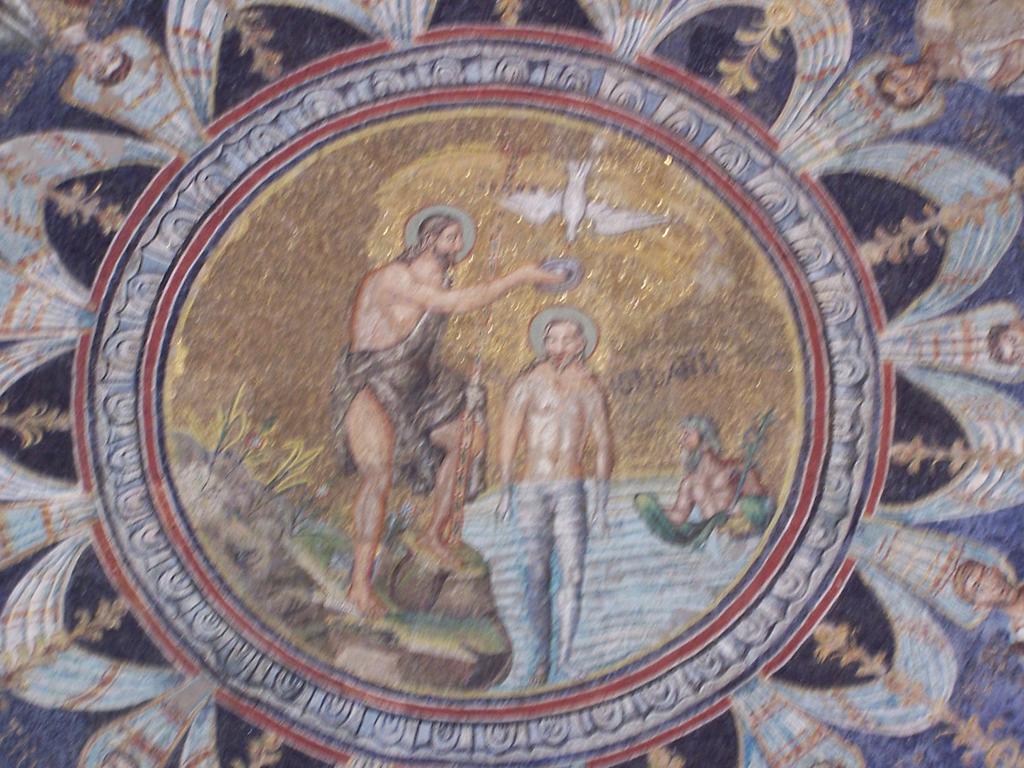 When they rise again slowly to answer the bishop's questions, they would see his head surrounded by a large ring, almost a halo, painted onto the wall in back of the font. Gold and blues glitter as the light hits the mosaic stones. It is truly unbelievable to behold and find yourself wondering how the ritual went so many years ago.
We left Ravenna after two nights, after having seen those three magnificent examples of architecture and religiious belief in the Dark Ages. (The cathedral had been brought "up to date" in the Renaissance, with ungainly but modern paintings having been added in the blank spaces of the ceiling.) We agreed that we would take the auto strada to get out of town. Surely getting out of town wouldn't be as bad and lengthy as getting in?
It almost was, as we found ourselves having to turn contrary to the map. But we got back on the right road, and drove up to the ticket booth to begin the auto strade.
Except that I couldn't figure out what to do at the ticket booth. I couldn't pay money, it wouldn't allow for it. Finally the light went on and Val said, "Oh, we just take the ticket!" We then figured out that when we exit the auto strade, we punch the ticket, and the machine will tell us how much to pay according to how far we've traveled. Ingenious.
We hit the auto strade with renewed enthusiasm for our trip, having just witnessed what few have ever seen in Ravenna, and with a firm belief that "we can do this!" And driving on the auto strade in a straight line seemed a lot easier than finding your way in a little town. We decided that I would drive, for the most part, while Val navigated. The division of labor would save us, we were certain.
The auto strade usually has three lanes of varying speeds:
The right lane: Go the speed limit.
The middle lane: Go slightly above the speed limit.
The left lane: What speed limit?
I discovered almost immediately that if I stuck a toe into the faster lane, I would find a car driving up my butt, coming out of nowhere at tremendous speeds. So I learned to first, decide if I really do want to get into that other lane, and then, secondly, pull the wheel sharply and go like hell until I could get over into the right lane again. When that other car narrowly misses you because you're too slow, and you see the Renault's bumper just inches away from your own, you try not to take it personally. They don't. It's just driving.
So we escaped the Bermuda Triangle of Ravenna only to find ourselves in another of Dante's rings of Purgatory, the speedy auto strade.
My Dream Vacation, Part 3: Siena

We had planned to take a day trip to Siena and San Gimignano with a local tour company after a couple of days to recover from jet lag, so at 8:30 in the morning on Friday, we walked over to the train station and found the proper bus. We had two languages onboard, and so had the same tour guide speak in both English and Spanish. The drive to Siena, which was about an hour and a half south of Firenze, was very pleasant in the air-conditioned tour bus.
Roberto handed us off to Margarita, our Siena tour guide, as soon as we got to the city square. Margarita was a delightful woman in her mid-40's. She had lived in Siena for the past 20 years, but her husband is originally from Siena. He is actually a Snail, she told Val in a private conversation, from that local district.
When the group surrounded her, she pointed upward. "Do you see the flag waving above us?" We saw a yellow and green flag, and if you looked closely, you could see the caterpillar on the flag. "The horse race was just run two days ago, and the Caterpillars won. Therefore, the Caterpillars have the right to run their flag up all over town!" She also told us that various townspeople will have scarves of the victorious district around their necks, and in some extreme cases, some of the men will be sucking from pacifiers. "It's like they are reborn," she said with a smile but not a smirk. This is serious business.
Every few steps we walked in Siena, we saw different flags or markings of another district. The dragon. The rhino. Fascinating.
Although we fairly flew up the streets on the way to the Duomo, it was easy to see that this Roman city was full of charm. Full of tourists, too, although not overly so, now that the annual race was last weekend.
The Duomo was located next to the hospital. I learned that Siena was a natural town on the pilgrimage to Rome, and thus the hospital was born. Hospital in this sense meant a place that would take care of travelers by offering a bed to sleep in and food. The heat was beginning to be oppressive even though it wasn't quite 11 in the morning. The Duomo on the outside is large but not necessarily compelling. However, once you walk inside, you discover instantly that it rivals St. Peter's in terms of artwork filling up every single inch of space.
While we were looking at the mosaics on the floor, some of which were being restored as we were there, one of the teenagers in our party fainted due to the heat. They took her over to get some water and she seemed fine. When we sat with the family during lunch, the mother related that her daughter has often fainted. Here, however, it was obvious that she had no hat and carried no water.

Siena is a fascinating Roman city. The aqueduct system was the only thing that kept Siena alive in the Roman day, as it had no outside source of water like a lake or river. The sloping cobblestone streets spoke to me as I climbed my way through the city's alleyways.
At lunchtime, Val and I opted to join Roberto at lunch in the Black Rooster. The Black Rooster is a cavern, and its small eating area is totally underground, down some steep stairs. All the food, we noticed, had to be toted up and down the stairs by the wait staff. The food was marvelous! We had a four-course meal consisting of small portions of antipasti, vegetable soup, pasta with cheese and some flecks of meat, and cheese. And the bread was the best, but I found I was declaring that at every meal.
 After this somewhat heavy meal, however, we followed Roberto quickly into the heat of Siena and to the large square where we would meet the rest of the group. Then we raced back down to where the bus was parked, a good quarter-mile away. In the heat, after the heavy meal (of which he partook), walking quickly when there were obviously some disabled tourists along was unconscionable in my mind. To make this personal, by the time I returned to the bus, I was flushed and my face was beet red. It took 30 minutes in the air-conditioned bus for me to return to normal.
And by that time, we were in San Gimignano, a medieval town totally behind imposing city walls that still stand. San Gimignano in my mind, however, was a complete bust. After climbing up the streets (about 3 blocks) to get to the gate, we found that the only thing that awaited us was a thoroughly modern commercial village, full of knickknacks and gelato. And it was hard to escape the heat.
Still, it was a great day for sightseeing and learning about Italy's medieval towns, towns which spent most of their resources defending against would-be attackers. I loved Siena. The time we had there was spent running after the tour guide rather than plumbing its depths. I would love to return.
Monday, July 11, 2005
My Dream Vacation, Part 2: Firenze
The Hotel Adler Cavalieri on the Via Della Scala allowed us to roam around Firenze all day, even in horrible heat. We would check the temperature on channel 10 every day (15 minutes in Italian, 15 minutes in English) and I would try to make the quick conversion to Fahrenheit. The first few days were blistering. However, even with jet lag, we jumped out of bed early the next morning, luxuriated in that huge shower, and headed for the Duomo with our little city maps in hand. We saw the Duomo -- or, actually, we saw Giotto's tower -- looming large before us as we walked down the narrow, winding streets.
I noticed immediately that cars did not have much respect for pedestrians. We are the enemy or even the targets. And narrow cobblestone streets didn't slow these little European cars down. And when we entered areas that cars couldn't reach, thinking we were safe, we were accosted constantly by scooters -- Vespa. Like mosquitoes, they would whiz past my ear when I wasn't looking, barely missing me by inches. And the bicycles were just as bad, just as fast, and could go where no man has gone before.
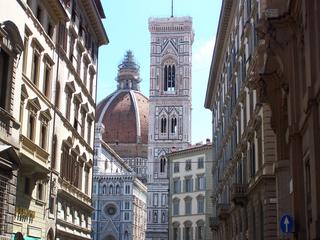 When we got to the piazza with the tower and Duomo, we immediately noticed an octagonal building right before the cathedral. In fact, this older-looking building prevented anyone from taking pictures of the cathedral straight-on; I remember hearing one American complaining about it, as he tried shooting his camera from different angles. The baptistery is centuries older than the Duomo, and yet only seemed to attract attention because of its famous doors: Ghiberti's bronze Gates of Paradise (supposedly named by Michelangelo when he first saw them). I understand Ghiberti spent over two decades carving these Biblical scenes out of bronze, just because nothing he produced was ever good enough.
But the story of the battistero is utterly fascinating. Since Val did a lot of graduate work on medieval religious art and architecture, I had my own personal guide to the baptistery. We had a seat at one of the wonderful outdoor cafes in the square, and I watched the round baptistery as she told the story.
In those days, baptism was performed on adult men. They would be rounded up at night in a raid, and one-by-one would be marched into the imposing baptistry, which was only used once a year. The bishop would ask the novice to swear each time, and each time he uttered "I swear", the priest holding him would kick out his knees so that he would fall backwards, face up into total immersion of the baptismal waters of the font. They would keep him down just enough so that he would wonder if he was really going to drown, rising only to see the artwork on the top of the ceiling: Christ welcoming him, it seems, to Christendom, except that some figures on the ceiling suggested that he was being welcomed into death. How frightening it must have been for them! After their baptism, they were marched straight into the opening of the cathedral, or Duomo, next door. Hence the closeness of the two buildings.
"With stories like that," Val told me, with a gleam in her eye, "who neeeds the Renaissance?"
I do. And so I insisted that we see Michelangelo's David. Luckily, we accompanied a tour, included in our Firenze city tour, so that we could skip the hour-long line wrapped around the Accademie. Since I had been here last -- 10 years ago? -- David has a barrier around him to protect him from well-wishers. And after I had gotten over my shock-and-awe at seeing this gorgeous sculpture, I could for the first time, notice some irregularities in the form itself, and enter into a thoroughly riveting discussion on why Michelangelo made the choices he did.
Val and I both agreed that this would not be a museum-seeking trip this time. We had little time to waste. Besides....Firenze is an open-door museum! Everywhere you turn, you find masterpieces in architecture all over the city, topped with its noted red tile.
Every day, due to jet lag and the sheer exhaustion of walking an average of 4 miles a day in the heat, we went back to the Hotel Adler to catch a nap in the afternoon. We began to notice how cold the room had become, although when we first entered the room, it felt delicious to us.
We discovered a restaurant close to our hotel. Amusingly it had the same menu, with the same English subtitle misspellings, as another restaurant we found close to the Accademie. This restaurant, air-conditioned inside, had helpful young wait staff and a variety of menu items. Each item we tried was delicioso. And we noticed that, when the patron next to us had finished, they were served a small glass of lemony-yellow liquid. This was limoncello, and we too were able to sample it. It's alcoholic, rather a shock after the pasta, a gift from the restaurant to our palate. Incredibly lemony with a bite to it. We would remember this.
What a wonderful custom in Italy, to consume languourously a large lunch consisting of multiple courses over the period of noon to about 3 pm. Indeed, most shops closed during that time, leaving the American tourist to find a bar that was open or go back to nap at the hotel. Or both.
One night, in our search for the meeting point of the Siena tour the next day, we found a restaurant near the train station, one in several chain restaurants throughout Italy. I have forgotten the name, but it's Pasta R Us -- well, not exactly, but you get the idea. The amazing part is that the meal we had there was delicious! And a great deal cheaper than others we had had. However, the limoncello afterwards was not gratis, and was a sickly yellow rather than a bright hue, denoting a drop in quality.
The food has great variety, of course, in Firenze but pasta is king, or at least is primi patti and for what I usually reached. No garlic is used in Firenze, however; you'd have to go farther north for that influence. Cream sauces were prevalent. And a lot of pesce, or fish, dishes, done all sorts of weird ways.
It was during this trip that I decided that Florence -- Firenze -- is my favorite European city. It's modern, it's medieval, it's Renaissance. Its people are curious, beautiful, fast-moving (and not just on scooters). Art is there to pluck like an overripe bunch of grapes off the vine. It has everything.
I became a little ill one night, and was hesitant to leave the hotel. George told me I should call the illness Luciano's Revenge. Perhaps an amalgam of jet lag and the heat, it nevertheless kept us in the hotel one night, wandering up to the hotel's bar on the highest floor. Unfortunately, the barman did not want to go downstairs for food, so we just ate a few of the h'ors doeurves available. Luciano disappeared by morning. And, as it turned out, it was time for us to move on as well.
Firenze even appeals to the fictional villain. One apothecary shop was notably included as a scene in the movie Hannibal. Dr. Lecter (Anthony Hopkin) walked into the store and ordered up several herbal remedies. The store itself is absolutely real. Originally a storefront for monks (and the monastery is still in the back), right on the Via Della Scala, it's a series of marble and wood furniture rooms with thousands of herbal possibilities, each of which is available commercially to the private citizen.
I noticed immediately that cars did not have much respect for pedestrians. We are the enemy or even the targets. And narrow cobblestone streets didn't slow these little European cars down. And when we entered areas that cars couldn't reach, thinking we were safe, we were accosted constantly by scooters -- Vespa. Like mosquitoes, they would whiz past my ear when I wasn't looking, barely missing me by inches. And the bicycles were just as bad, just as fast, and could go where no man has gone before.
 When we got to the piazza with the tower and Duomo, we immediately noticed an octagonal building right before the cathedral. In fact, this older-looking building prevented anyone from taking pictures of the cathedral straight-on; I remember hearing one American complaining about it, as he tried shooting his camera from different angles. The baptistery is centuries older than the Duomo, and yet only seemed to attract attention because of its famous doors: Ghiberti's bronze Gates of Paradise (supposedly named by Michelangelo when he first saw them). I understand Ghiberti spent over two decades carving these Biblical scenes out of bronze, just because nothing he produced was ever good enough.
But the story of the battistero is utterly fascinating. Since Val did a lot of graduate work on medieval religious art and architecture, I had my own personal guide to the baptistery. We had a seat at one of the wonderful outdoor cafes in the square, and I watched the round baptistery as she told the story.
In those days, baptism was performed on adult men. They would be rounded up at night in a raid, and one-by-one would be marched into the imposing baptistry, which was only used once a year. The bishop would ask the novice to swear each time, and each time he uttered "I swear", the priest holding him would kick out his knees so that he would fall backwards, face up into total immersion of the baptismal waters of the font. They would keep him down just enough so that he would wonder if he was really going to drown, rising only to see the artwork on the top of the ceiling: Christ welcoming him, it seems, to Christendom, except that some figures on the ceiling suggested that he was being welcomed into death. How frightening it must have been for them! After their baptism, they were marched straight into the opening of the cathedral, or Duomo, next door. Hence the closeness of the two buildings.
"With stories like that," Val told me, with a gleam in her eye, "who neeeds the Renaissance?"
I do. And so I insisted that we see Michelangelo's David. Luckily, we accompanied a tour, included in our Firenze city tour, so that we could skip the hour-long line wrapped around the Accademie. Since I had been here last -- 10 years ago? -- David has a barrier around him to protect him from well-wishers. And after I had gotten over my shock-and-awe at seeing this gorgeous sculpture, I could for the first time, notice some irregularities in the form itself, and enter into a thoroughly riveting discussion on why Michelangelo made the choices he did.
Val and I both agreed that this would not be a museum-seeking trip this time. We had little time to waste. Besides....Firenze is an open-door museum! Everywhere you turn, you find masterpieces in architecture all over the city, topped with its noted red tile.
Every day, due to jet lag and the sheer exhaustion of walking an average of 4 miles a day in the heat, we went back to the Hotel Adler to catch a nap in the afternoon. We began to notice how cold the room had become, although when we first entered the room, it felt delicious to us.
We discovered a restaurant close to our hotel. Amusingly it had the same menu, with the same English subtitle misspellings, as another restaurant we found close to the Accademie. This restaurant, air-conditioned inside, had helpful young wait staff and a variety of menu items. Each item we tried was delicioso. And we noticed that, when the patron next to us had finished, they were served a small glass of lemony-yellow liquid. This was limoncello, and we too were able to sample it. It's alcoholic, rather a shock after the pasta, a gift from the restaurant to our palate. Incredibly lemony with a bite to it. We would remember this.
What a wonderful custom in Italy, to consume languourously a large lunch consisting of multiple courses over the period of noon to about 3 pm. Indeed, most shops closed during that time, leaving the American tourist to find a bar that was open or go back to nap at the hotel. Or both.
One night, in our search for the meeting point of the Siena tour the next day, we found a restaurant near the train station, one in several chain restaurants throughout Italy. I have forgotten the name, but it's Pasta R Us -- well, not exactly, but you get the idea. The amazing part is that the meal we had there was delicious! And a great deal cheaper than others we had had. However, the limoncello afterwards was not gratis, and was a sickly yellow rather than a bright hue, denoting a drop in quality.
The food has great variety, of course, in Firenze but pasta is king, or at least is primi patti and for what I usually reached. No garlic is used in Firenze, however; you'd have to go farther north for that influence. Cream sauces were prevalent. And a lot of pesce, or fish, dishes, done all sorts of weird ways.
It was during this trip that I decided that Florence -- Firenze -- is my favorite European city. It's modern, it's medieval, it's Renaissance. Its people are curious, beautiful, fast-moving (and not just on scooters). Art is there to pluck like an overripe bunch of grapes off the vine. It has everything.
I became a little ill one night, and was hesitant to leave the hotel. George told me I should call the illness Luciano's Revenge. Perhaps an amalgam of jet lag and the heat, it nevertheless kept us in the hotel one night, wandering up to the hotel's bar on the highest floor. Unfortunately, the barman did not want to go downstairs for food, so we just ate a few of the h'ors doeurves available. Luciano disappeared by morning. And, as it turned out, it was time for us to move on as well.
Firenze even appeals to the fictional villain. One apothecary shop was notably included as a scene in the movie Hannibal. Dr. Lecter (Anthony Hopkin) walked into the store and ordered up several herbal remedies. The store itself is absolutely real. Originally a storefront for monks (and the monastery is still in the back), right on the Via Della Scala, it's a series of marble and wood furniture rooms with thousands of herbal possibilities, each of which is available commercially to the private citizen.
My Dream Vacation
My friend Val and I were talking about taking an international trip together during her break from school. What would be my itinerary, she asked, if I could go anywhere?
In the past two years I had pretty much resigned myself to the fact that I would no longer be traveling internationally. It's too expensive, it's too hard, and with iffy health it's not something to be taken lightly. However, my health has improved greatly in that time, and going with another friend is always cost-effective and just too much fun to ignore.
My favorite place, I believe, outside my homes of Oakland and Coronado is Italy, or rather, Tuscany and north of that. I have been twice to Florence, but frankly all I remember are little swatches of shopping and museums. I took tours both times, and I distinctly remember being placed in the middle of the piazza by the tour bus, never being able to find my way back. If I could go back, unescorted and - hey! maybe even by rental car so we could have the most freedom! - I will have died and gone to pasta heaven!
Since this was back in May 2005, we didn't have much time for travel that would begin at the end of June. After several email and a couple of visits, we nailed down our itinerary to Florence, Siena, Ravenna, possibly Venice, Padua, Verona and Mantua, with Bologna another possibility. After we got the serious Italy map out, we made Siena a day-tour from Florence, cut out Venice entirely, and streamlined our journey to these hotel stops:
Florence (aka Firenze): 5 nights
Ravenna: 2 nights
Vescovana (south of Padua): 1 night
Mantua: 1 night
Firenze airport for last night: 1 night
We worked with a Triple A travel agent in Los Angeles, a "brother" who had been to Italy several times and had sensible recommendations. He set us up with the Firenze hotels (coming and going), the rental car, and the airline tickets. We were ready to roll!
Okay, we all know what happens with dream vacations, or dream anything: reality finally sets in. Reality, unfortunately, hit us immediately. Our flight from Frankfurt to Firenze was delayed 5 hours due to rainstorms over Firenze. When we finally got up in the air, they announced halfway through the short flight that the storms would prevent us from landing in Firenze. Instead, we landed in Bologna, one of the smallest airports I have ever seen. Without any further pronouncements on where to go, we managed to file, like ants, into a bus at the curb for the 2-hour drive from Bologna Airport to Firenze Airport.
When we arrived at Firenze Airport at 7:30 pm instead of 2:45 pm, we discovered that the Baspi Bus, the prepaid transport to our hotel in Firenze, was nowhere to be found. I used my new Euro coins to call on the pay phone, but no one answered at the tour office. It was, after all, pretty late by then. We stood in a long queue for the taxi, and the driver got us safely to the delightful Hotel Adler Cavalieri, a 3-star hotel near the train station and a 20-minute walk to the Duomo, etc. We marveled at the air conditioning in the room, the huuuuge shower stall in the rather nice bathroom, and, sodden with jetlag, took the desk clerk's suggestion of a late dinner at a real Italian restaurant right down the block.
I say "real," because only one person in the restaurant (I believe the owner) spoke any English at all. This was our first experience with an Italian menu (without subtitles!), and we spent a good 20 minutes reading it over and over, looking for clues in Italian words. Val had her phrase book, but that was slow going. And we were hungry.
The owner took pity on us, approached us and was very friendly, explaining in limited English what it was we were ordering. We still felt like we were gambling, but we would often find that to be so on this trip. You may not get exactly what you ordered, but it will be a delicious meal. That turned out to be the lovely truth every day we were in Italy. Buon appetito!
In the past two years I had pretty much resigned myself to the fact that I would no longer be traveling internationally. It's too expensive, it's too hard, and with iffy health it's not something to be taken lightly. However, my health has improved greatly in that time, and going with another friend is always cost-effective and just too much fun to ignore.
My favorite place, I believe, outside my homes of Oakland and Coronado is Italy, or rather, Tuscany and north of that. I have been twice to Florence, but frankly all I remember are little swatches of shopping and museums. I took tours both times, and I distinctly remember being placed in the middle of the piazza by the tour bus, never being able to find my way back. If I could go back, unescorted and - hey! maybe even by rental car so we could have the most freedom! - I will have died and gone to pasta heaven!
Since this was back in May 2005, we didn't have much time for travel that would begin at the end of June. After several email and a couple of visits, we nailed down our itinerary to Florence, Siena, Ravenna, possibly Venice, Padua, Verona and Mantua, with Bologna another possibility. After we got the serious Italy map out, we made Siena a day-tour from Florence, cut out Venice entirely, and streamlined our journey to these hotel stops:
Florence (aka Firenze): 5 nights
Ravenna: 2 nights
Vescovana (south of Padua): 1 night
Mantua: 1 night
Firenze airport for last night: 1 night
We worked with a Triple A travel agent in Los Angeles, a "brother" who had been to Italy several times and had sensible recommendations. He set us up with the Firenze hotels (coming and going), the rental car, and the airline tickets. We were ready to roll!

Okay, we all know what happens with dream vacations, or dream anything: reality finally sets in. Reality, unfortunately, hit us immediately. Our flight from Frankfurt to Firenze was delayed 5 hours due to rainstorms over Firenze. When we finally got up in the air, they announced halfway through the short flight that the storms would prevent us from landing in Firenze. Instead, we landed in Bologna, one of the smallest airports I have ever seen. Without any further pronouncements on where to go, we managed to file, like ants, into a bus at the curb for the 2-hour drive from Bologna Airport to Firenze Airport.
When we arrived at Firenze Airport at 7:30 pm instead of 2:45 pm, we discovered that the Baspi Bus, the prepaid transport to our hotel in Firenze, was nowhere to be found. I used my new Euro coins to call on the pay phone, but no one answered at the tour office. It was, after all, pretty late by then. We stood in a long queue for the taxi, and the driver got us safely to the delightful Hotel Adler Cavalieri, a 3-star hotel near the train station and a 20-minute walk to the Duomo, etc. We marveled at the air conditioning in the room, the huuuuge shower stall in the rather nice bathroom, and, sodden with jetlag, took the desk clerk's suggestion of a late dinner at a real Italian restaurant right down the block.
I say "real," because only one person in the restaurant (I believe the owner) spoke any English at all. This was our first experience with an Italian menu (without subtitles!), and we spent a good 20 minutes reading it over and over, looking for clues in Italian words. Val had her phrase book, but that was slow going. And we were hungry.
The owner took pity on us, approached us and was very friendly, explaining in limited English what it was we were ordering. We still felt like we were gambling, but we would often find that to be so on this trip. You may not get exactly what you ordered, but it will be a delicious meal. That turned out to be the lovely truth every day we were in Italy. Buon appetito!
Tuesday, June 21, 2005
The Fan of the Game
While Rick and I were sitting there in our seats,
right before the A's game started, an A's official
came and asked us if we had our tickets. We thought
it was just the ticket police, as usual. But then he
told me that I had been selected as the Oakland A's fan of the
game.
"You think it's random, but it isn't. We select the
person by seat number, then we tell everyone to act crazy in the
bottom of the 3rd inning. You wave your hat around,
then we pick you." I didn't have an A's hat on
(spring training one instead), so he gave me one. He
added, "Don't go anywhere in the bottom of the 3rd!"
He also told me to go to Member Services after the 3rd
inning to claim my prizes.
So, true enough, cameras showed up, and the announcer
told everyone to go crazy. I waved my A's hat, and
Stompy (that fuzzy elephant mascot) picked ME. He
shook my hand and then kissed me on the top of the
head, all in plain view of 15,000 fans on Diamond
Vision.
When I claimed my prize right after that, I had won
(1) a Rich Harden signed baseball! (2) A t-shirt
advertising their event, Play with the Pros;(3) A
chance to play with the pros (I filled out a card);
(4) a coupon for a 12-pack of Pepsi (I gave this to
Rick).
Rick told everyone in the section that we've been
coming to A's games for 15 years, and this is the
first time we've won anything.
The icing on this green-and-gold cake came the next day when I went to the post office. The teller, who has served me for several years when I mail out my eBay stuff, said, "Linda, was that you on Diamond Vision last night?"
Indeed it was. I tell you, you have definitely reached your 15 seconds of fame when the United States Post Office recognizes you.
right before the A's game started, an A's official
came and asked us if we had our tickets. We thought
it was just the ticket police, as usual. But then he
told me that I had been selected as the Oakland A's fan of the
game.
"You think it's random, but it isn't. We select the
person by seat number, then we tell everyone to act crazy in the
bottom of the 3rd inning. You wave your hat around,
then we pick you." I didn't have an A's hat on
(spring training one instead), so he gave me one. He
added, "Don't go anywhere in the bottom of the 3rd!"
He also told me to go to Member Services after the 3rd
inning to claim my prizes.
So, true enough, cameras showed up, and the announcer
told everyone to go crazy. I waved my A's hat, and
Stompy (that fuzzy elephant mascot) picked ME. He
shook my hand and then kissed me on the top of the
head, all in plain view of 15,000 fans on Diamond
Vision.
When I claimed my prize right after that, I had won
(1) a Rich Harden signed baseball! (2) A t-shirt
advertising their event, Play with the Pros;(3) A
chance to play with the pros (I filled out a card);
(4) a coupon for a 12-pack of Pepsi (I gave this to
Rick).
Rick told everyone in the section that we've been
coming to A's games for 15 years, and this is the
first time we've won anything.
The icing on this green-and-gold cake came the next day when I went to the post office. The teller, who has served me for several years when I mail out my eBay stuff, said, "Linda, was that you on Diamond Vision last night?"
Indeed it was. I tell you, you have definitely reached your 15 seconds of fame when the United States Post Office recognizes you.
Sunday, June 19, 2005
My First 5K Walk
I did it!!!
The Oakland A's-sponsored 5K Run (well, Walk for us) occurred on Sunday, June 19th, on a bright sunny morning in the A's parking lot.
Shawn and I showed up at the start line, and walked
the whole 5 kilometers with about 700 other runners
and walkers.
As we walked up to the Start line, Shawn lit a
cigarette. I had to laugh. As we began to walk out
of the Coliseum (currently McAfee Stadium), everybody
seemed to be having a good time. The people who were
serious about it were up at the front a good 15 minutes before the walk started, jockeying for
a good starting position.
We were motivated and humbled by a guy walking with us
-- Pete, walking with two crutches, the kind of
crutches you put your hand through, the kind that are likely
part of his daily routine for the rest of his life.
He was awesome. While we eventually passed him, he kept us
with us for a long time on the path, and finished the
whole 5K.
As we were approaching the one-mile mark (and our
first water station), Molly Jones passed us going the
other way. Go, Molly! We kept cheering the other
women who were actually running in this race.
Shawn and I finished numbers 699 and 700,
respectively, out of about 712. Not last, but
definitely not in the race. Not a problem. I was
happy that the two of us were able to raise $300 for
the fight against violence against women and children.
We believe the whole event raised over $30,000.
Pretty nice. And the race marks a level of achievement for me in my exercise program. I am very proud about that, and I'm looking forward to meeting the next set of obstacles toward the next level.
Oh, and at the end of the race, we went in to enjoy
the A's vs. the Phillies (A's won, 5 - 2). Amid
promises of getting out there more often to walk as
exercise, Shawn bought a four-pack of Krispy Kreme
donuts. Can you believe that??! (I had two,
thankyouverymuch.)
I hope the next challenge like this is just around the corner.
The Oakland A's-sponsored 5K Run (well, Walk for us) occurred on Sunday, June 19th, on a bright sunny morning in the A's parking lot.
Shawn and I showed up at the start line, and walked
the whole 5 kilometers with about 700 other runners
and walkers.
As we walked up to the Start line, Shawn lit a
cigarette. I had to laugh. As we began to walk out
of the Coliseum (currently McAfee Stadium), everybody
seemed to be having a good time. The people who were
serious about it were up at the front a good 15 minutes before the walk started, jockeying for
a good starting position.
We were motivated and humbled by a guy walking with us
-- Pete, walking with two crutches, the kind of
crutches you put your hand through, the kind that are likely
part of his daily routine for the rest of his life.
He was awesome. While we eventually passed him, he kept us
with us for a long time on the path, and finished the
whole 5K.
As we were approaching the one-mile mark (and our
first water station), Molly Jones passed us going the
other way. Go, Molly! We kept cheering the other
women who were actually running in this race.
Shawn and I finished numbers 699 and 700,
respectively, out of about 712. Not last, but
definitely not in the race. Not a problem. I was
happy that the two of us were able to raise $300 for
the fight against violence against women and children.
We believe the whole event raised over $30,000.
Pretty nice. And the race marks a level of achievement for me in my exercise program. I am very proud about that, and I'm looking forward to meeting the next set of obstacles toward the next level.
Oh, and at the end of the race, we went in to enjoy
the A's vs. the Phillies (A's won, 5 - 2). Amid
promises of getting out there more often to walk as
exercise, Shawn bought a four-pack of Krispy Kreme
donuts. Can you believe that??! (I had two,
thankyouverymuch.)
I hope the next challenge like this is just around the corner.
Tuesday, May 31, 2005
Help me -- I’ve fallen into the buffet and I can’t get up.
I’m addicted to food. No, that’s not really true. I’m addicted to sugar, and all things that end up sugar in my bloodstream. Bread, potatoes. Ice cream.
I retired in December 2003. Back in the recesses of my mind was a slender thought that I would have to take hold of my health and strangle it back to life. I’m in my mid-50’s. It’s hard to get up in the morning with all that stiff activity. A back that won’t cooperate and is in almost constant pain. At least I stopped having cramps in my legs after the surgery in 2002.
So in February 2004, I joined a weight-loss group at my clinic on MacArthur. I saw the flyer, and impulsively wrote my name and phone number on it. I thought I’d never hear from them. But two months later, they called me to inform me that the group was starting. That was a year and some months ago.
I started going to classes every Tuesday afternoon with nutritionists Nancy and Andrea, and later Jessica. My initial thought was, gee, nobody must have a job if they can come on a weekday afternoon. But they were all late, always! Nancy kept hinting, loudly, that people need to be on time. Finally she took a poll. As it turned out, nobody owned a car. They all were waiting for a ride that may or may not be on time. Usually not.
That was my first inkling that these people were not my clones. These were people I didn’t know anything about. They were foreign to me. And finally, I thought, we have nothing in common.
That wasn’t true, of course. We all had medical problems. And there was the obvious: we all needed to lose weight because of our medical problems.
It certainly was a shock, though, to learn that some had no income, except for public assistance. Some of them, notably a woman recovering from a strroke with her very overweight (and distinerested) 18-yr-old daughter, didn’t have a clue about losing weight but were sure they couldn’t afford it. They could buy Kentucky Fried Chicken but couldn’t buy vegetables or rice. I didn’t buy their logic but I could see where they acquired it. And how they believed it. Wow.
I lost 40 pounds by following Nancy’s and Jessica’s program. I went from 227 lbs on February 10, 2004, to 185 lbs on Decembert 1, 2004.
The program was rather simple:
1. Portion control - e.g., a steak should measure the size of a deck of cards.
2. Fat control. Change the foods you eat to reduce fat. No more fast food. No more fried foods. Read labels.
3. Reduce sugar content. This was probably the most intuitive but the hardest for me.
4. Try to follow the food pyramid -- don't forget those portions of fruits and vegetables.
5. Exercise.
Exercise was the easiest. I had always had pain in my legs, at least in the last 10 years, but once the blood was getting to my legs (thank you, surgeon), I stopped having cramps or shin splints. I could walk again without pain. However, I had no stamina. So, to build up, I went down to Lake Merritt or the San Leandro Marina and started walking: 20 minutes then 30 minutes at a time, then 45 minutes, then one hour.
Courtesy of the MacArthur clinic, I received a pedometer, which sharpened my focus on walking. I now try to walk 10,000 steps, the goal for a diabetic every day. 10,000 steps a day translates to achieving at least 7,000 steps during my walk, which is about 3 miles, and the other 3,000 will come from other daily activities. Lake Merritt is 3 miles from end to end: perfect. And the Marina measures a 1 mile or 1.5 mile trek: easy. I try to walk 6 times a week.
So, according to my calculations, I figured I’d be able to get to my goal weight of 175 by February, a year after I started the program. Didn’t happen.
In fact, I went up, gained weight. Aarrrgggh! It would be easy to say that life got in the way, but it didn’t. Ice cream got in the way. Chocolate. Bread. Butter. All the things I love that I had not been eating kept inching their way back into my life, more specifically my mouth. I can cheat, I thought. If I gain a pound or two, I can lose it again. No, I can’t. I haven’t been able to get on the same chugging railroad.
So every week when I went back to the group at MacArthur, I would tell them my story of the week. I had some dessert a couple nights. I lost sight of portion control. (Yes, dammit, I know how large a steak should be. A deck of cards!? I’m hungry!) “I know the program,” I would whine at them. “I just can’t seem to follow it.” They knew exactly what I was talking about. These people are my truth barometer.
I seem to have more in common with them than I initially thought. There are a couple in there who have had strokes. They’re impaired now. They’re angry about it, and trying to use that anger to move toward positive goals. They’re determined. There are others who have diabetes, like me. Sugar is poison, but they can’t resist it. There are others who just can’t put down that Big Mac, like the stroke victim’s teenage daughter who didn’t think our program applied to her. There are different types of people in this group, that’s for sure, but we’re all here for the same reason, to improve our health. And we recognize by being here that we can’t do it alone.
I can’t do it alone. I find I behave better when I’m eating with a friend who is on the same general program. She won’t criticize what I do, that’s for sure. But we both seem more inclined to stick to the program because the other is watching. Maybe it’s the shame factor. It works, whatever it is. And I need the MacArthur group.
So here I am. I haven’t weighed myself today, but I believe I’m at around 188. I hover in the same 5 pounds, 185 - 190, hoping to God it’s not 190 today. It’s one day at a time. Working the program one day at a time. I have an addiction, you see. That’s what we addicts have to do to get to the next day.
I retired in December 2003. Back in the recesses of my mind was a slender thought that I would have to take hold of my health and strangle it back to life. I’m in my mid-50’s. It’s hard to get up in the morning with all that stiff activity. A back that won’t cooperate and is in almost constant pain. At least I stopped having cramps in my legs after the surgery in 2002.
So in February 2004, I joined a weight-loss group at my clinic on MacArthur. I saw the flyer, and impulsively wrote my name and phone number on it. I thought I’d never hear from them. But two months later, they called me to inform me that the group was starting. That was a year and some months ago.
I started going to classes every Tuesday afternoon with nutritionists Nancy and Andrea, and later Jessica. My initial thought was, gee, nobody must have a job if they can come on a weekday afternoon. But they were all late, always! Nancy kept hinting, loudly, that people need to be on time. Finally she took a poll. As it turned out, nobody owned a car. They all were waiting for a ride that may or may not be on time. Usually not.
That was my first inkling that these people were not my clones. These were people I didn’t know anything about. They were foreign to me. And finally, I thought, we have nothing in common.
That wasn’t true, of course. We all had medical problems. And there was the obvious: we all needed to lose weight because of our medical problems.
It certainly was a shock, though, to learn that some had no income, except for public assistance. Some of them, notably a woman recovering from a strroke with her very overweight (and distinerested) 18-yr-old daughter, didn’t have a clue about losing weight but were sure they couldn’t afford it. They could buy Kentucky Fried Chicken but couldn’t buy vegetables or rice. I didn’t buy their logic but I could see where they acquired it. And how they believed it. Wow.
I lost 40 pounds by following Nancy’s and Jessica’s program. I went from 227 lbs on February 10, 2004, to 185 lbs on Decembert 1, 2004.
The program was rather simple:
1. Portion control - e.g., a steak should measure the size of a deck of cards.
2. Fat control. Change the foods you eat to reduce fat. No more fast food. No more fried foods. Read labels.
3. Reduce sugar content. This was probably the most intuitive but the hardest for me.
4. Try to follow the food pyramid -- don't forget those portions of fruits and vegetables.
5. Exercise.
Exercise was the easiest. I had always had pain in my legs, at least in the last 10 years, but once the blood was getting to my legs (thank you, surgeon), I stopped having cramps or shin splints. I could walk again without pain. However, I had no stamina. So, to build up, I went down to Lake Merritt or the San Leandro Marina and started walking: 20 minutes then 30 minutes at a time, then 45 minutes, then one hour.
Courtesy of the MacArthur clinic, I received a pedometer, which sharpened my focus on walking. I now try to walk 10,000 steps, the goal for a diabetic every day. 10,000 steps a day translates to achieving at least 7,000 steps during my walk, which is about 3 miles, and the other 3,000 will come from other daily activities. Lake Merritt is 3 miles from end to end: perfect. And the Marina measures a 1 mile or 1.5 mile trek: easy. I try to walk 6 times a week.
So, according to my calculations, I figured I’d be able to get to my goal weight of 175 by February, a year after I started the program. Didn’t happen.
In fact, I went up, gained weight. Aarrrgggh! It would be easy to say that life got in the way, but it didn’t. Ice cream got in the way. Chocolate. Bread. Butter. All the things I love that I had not been eating kept inching their way back into my life, more specifically my mouth. I can cheat, I thought. If I gain a pound or two, I can lose it again. No, I can’t. I haven’t been able to get on the same chugging railroad.
So every week when I went back to the group at MacArthur, I would tell them my story of the week. I had some dessert a couple nights. I lost sight of portion control. (Yes, dammit, I know how large a steak should be. A deck of cards!? I’m hungry!) “I know the program,” I would whine at them. “I just can’t seem to follow it.” They knew exactly what I was talking about. These people are my truth barometer.
I seem to have more in common with them than I initially thought. There are a couple in there who have had strokes. They’re impaired now. They’re angry about it, and trying to use that anger to move toward positive goals. They’re determined. There are others who have diabetes, like me. Sugar is poison, but they can’t resist it. There are others who just can’t put down that Big Mac, like the stroke victim’s teenage daughter who didn’t think our program applied to her. There are different types of people in this group, that’s for sure, but we’re all here for the same reason, to improve our health. And we recognize by being here that we can’t do it alone.
I can’t do it alone. I find I behave better when I’m eating with a friend who is on the same general program. She won’t criticize what I do, that’s for sure. But we both seem more inclined to stick to the program because the other is watching. Maybe it’s the shame factor. It works, whatever it is. And I need the MacArthur group.
So here I am. I haven’t weighed myself today, but I believe I’m at around 188. I hover in the same 5 pounds, 185 - 190, hoping to God it’s not 190 today. It’s one day at a time. Working the program one day at a time. I have an addiction, you see. That’s what we addicts have to do to get to the next day.
Wednesday, April 27, 2005
Sitting in the Stands at an A's game...
An old(er) man and his wife (probably both in mid-70's) sat down in front of me today at the A's game. Field level seats, on the aisle, allll the way up the stairs behind home plate, well under the overhang (and since it rained today, that was okay).
It took him 3 tries to hook his cane on the seat. He almost got me, but I kept ducking. As I'm sitting there, pre-game, eating my Oriental chicken salad, a small wooden object hit me lightly in the shoulder and bounced off my jacket. I found a tiny red sharpened pencil on the cement floor and tried to hand it back to the old man, but he kept ignoring me. Finally his wife took it from me, thanked me, and handed it to him. I said to him, "You must've thrown it over your shoulder." He wondered why he couldn't find it, took it, and started making marks on his scorecard without acknowledging my existence.
I'm going to be like that when I get older, I thought. Except I'll have a better hat, an A's cap. But I'll have the cane, and I, too, will be sitting close to the exit so that I don't have to climb the stairs.
His scorecard was as old as he was. But since he hadn't gotten through all the sheets, he must not go to that many games a year. But when he does, by golly, he whips out his old scorecard book and keeps score.
He barely talked to his wife all game, intent on getting the plays down on paper. It didn't help either one of us that the scoreboard was obscured from view by the overhanging concrete. He kept leaning forward to see a sliver of the bottom part of the scoreboard, occasionally lifting the binoculars to his eyes so that he could pick up the details.
A woman in an official-looking A's outfit came to our section and started handing out surveys on how well the fans liked the stadium experience. She spoke to him but he didn't hear her. She spoke again, trying to hand him the survey, but he ignored her. Finally his wife reached across him and took the survey and pen. He leaned toward the young woman to see what she wanted. When she said, "We just want to find out how we're doing," he shouted, barely above a whisper, "Here's how you're doing!" and shoved the scorecard in her face. She laughed.
His wife seemed so patient. She watched the game as silently as he did. When they stood up for the 7th-inning stretch song "Take Me Out to the Ballgame," she had difficulty becoming fully erect. He helped her in the last millisecond, a good two-thirds the way through the song. I didn't think it was required of us to stand during this break in our pasttime, but apparently it is.
Yup, I'm going to be just like him. Tottering out to the ballgames. Using binoculars to aid my tired eyes. Keeping track of the players and the action in front of me and ignoring (and not hearing) the rest. If being put out to pasture means going to the ballfield, I'm halfway in the barn right now. Except I've got a better hat.
It took him 3 tries to hook his cane on the seat. He almost got me, but I kept ducking. As I'm sitting there, pre-game, eating my Oriental chicken salad, a small wooden object hit me lightly in the shoulder and bounced off my jacket. I found a tiny red sharpened pencil on the cement floor and tried to hand it back to the old man, but he kept ignoring me. Finally his wife took it from me, thanked me, and handed it to him. I said to him, "You must've thrown it over your shoulder." He wondered why he couldn't find it, took it, and started making marks on his scorecard without acknowledging my existence.
I'm going to be like that when I get older, I thought. Except I'll have a better hat, an A's cap. But I'll have the cane, and I, too, will be sitting close to the exit so that I don't have to climb the stairs.
His scorecard was as old as he was. But since he hadn't gotten through all the sheets, he must not go to that many games a year. But when he does, by golly, he whips out his old scorecard book and keeps score.
He barely talked to his wife all game, intent on getting the plays down on paper. It didn't help either one of us that the scoreboard was obscured from view by the overhanging concrete. He kept leaning forward to see a sliver of the bottom part of the scoreboard, occasionally lifting the binoculars to his eyes so that he could pick up the details.
A woman in an official-looking A's outfit came to our section and started handing out surveys on how well the fans liked the stadium experience. She spoke to him but he didn't hear her. She spoke again, trying to hand him the survey, but he ignored her. Finally his wife reached across him and took the survey and pen. He leaned toward the young woman to see what she wanted. When she said, "We just want to find out how we're doing," he shouted, barely above a whisper, "Here's how you're doing!" and shoved the scorecard in her face. She laughed.
His wife seemed so patient. She watched the game as silently as he did. When they stood up for the 7th-inning stretch song "Take Me Out to the Ballgame," she had difficulty becoming fully erect. He helped her in the last millisecond, a good two-thirds the way through the song. I didn't think it was required of us to stand during this break in our pasttime, but apparently it is.
Yup, I'm going to be just like him. Tottering out to the ballgames. Using binoculars to aid my tired eyes. Keeping track of the players and the action in front of me and ignoring (and not hearing) the rest. If being put out to pasture means going to the ballfield, I'm halfway in the barn right now. Except I've got a better hat.
Subscribe to:
Posts (Atom)